
















Table of Contents
Get A Free Quote
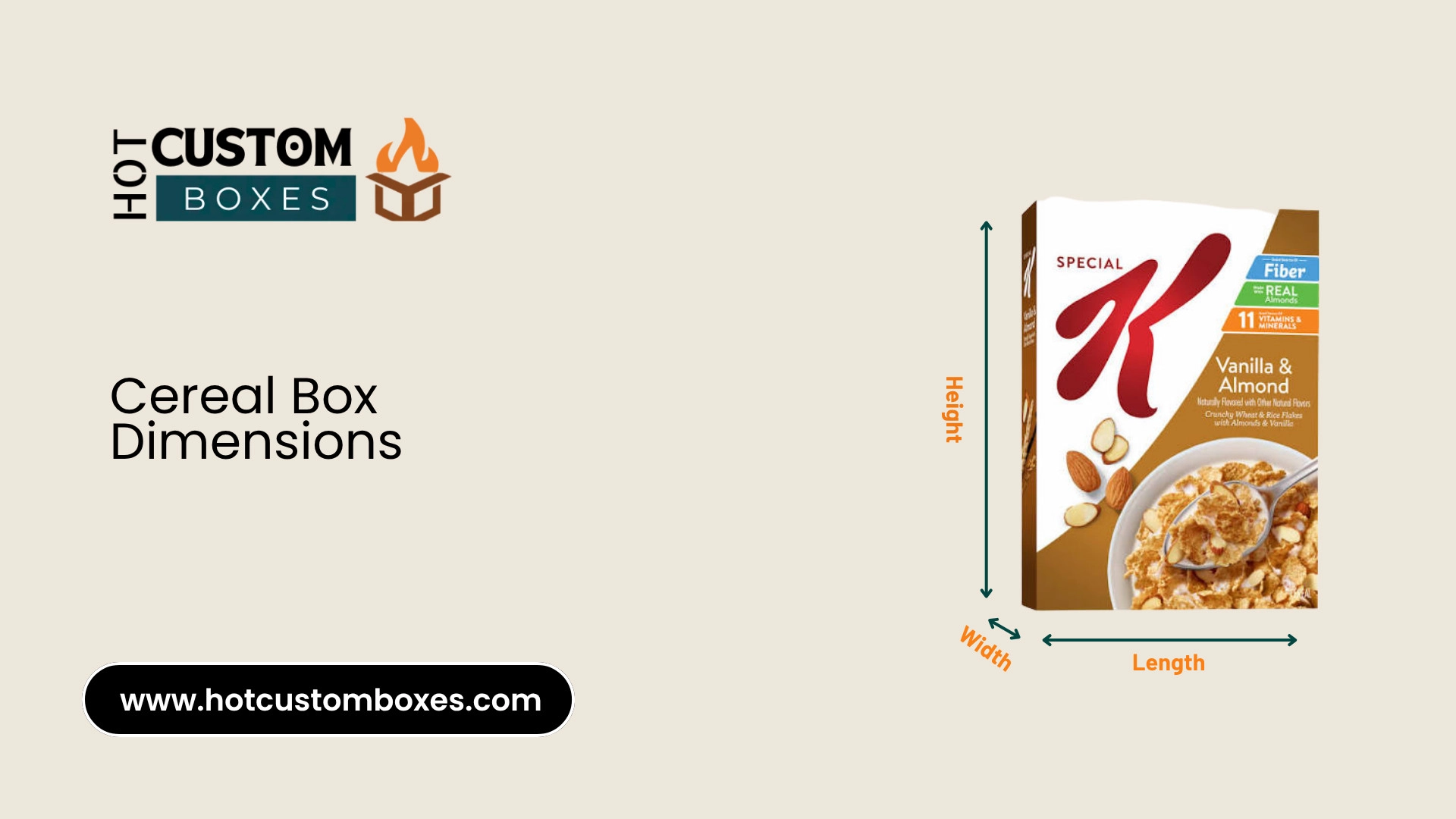
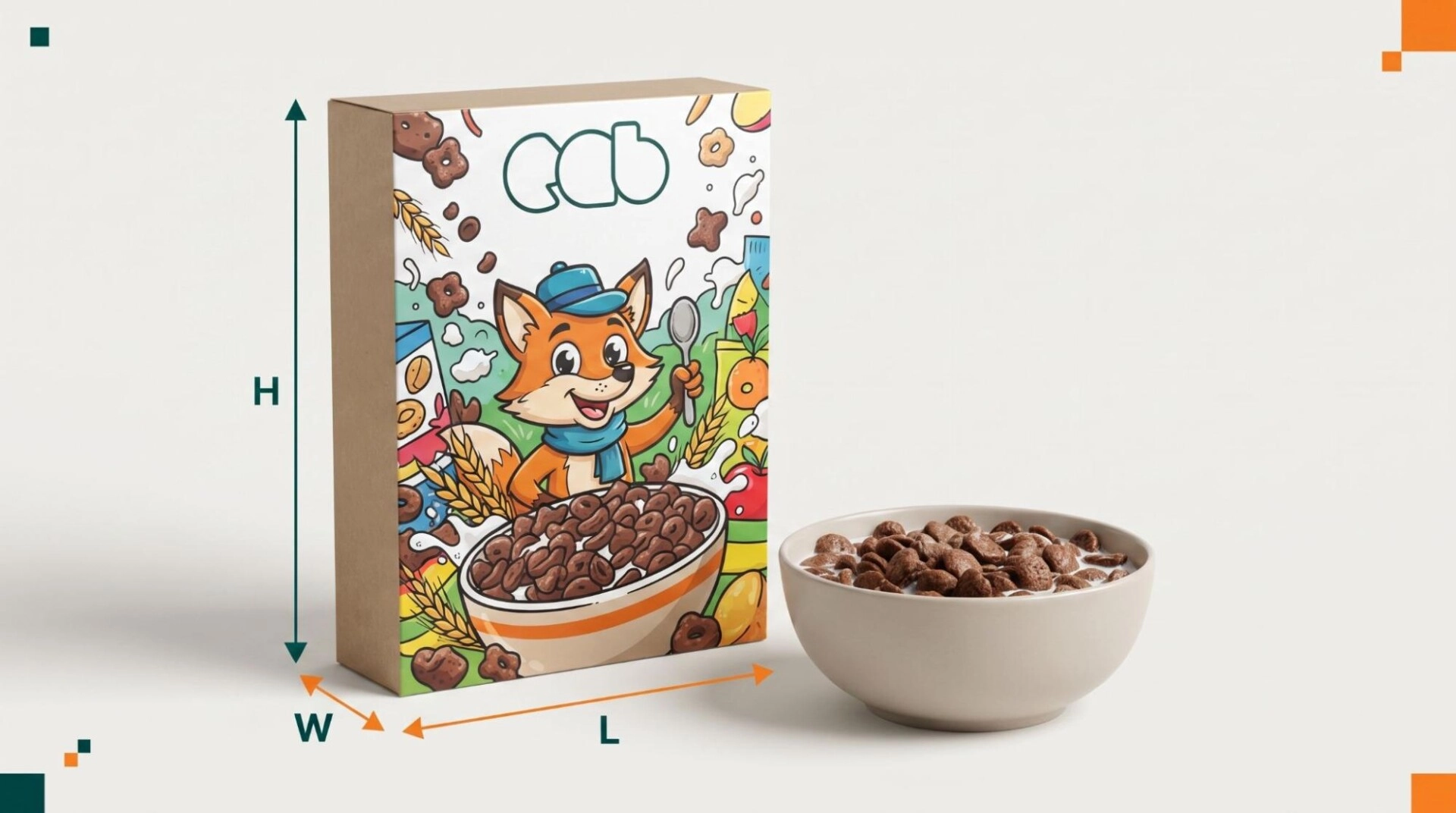
The exact height of cereal boxes depends on its quantity, box style, brand, and target market. Small single-serving boxes may be under 8 inches tall, while family-size cereal boxes can be 15 inches or more. Height is only one factor that is considered in complete cereal box size. Packaging manufacturers describe box dimensions in this order:
Length × Width × Height
What Is the Average Height of a Cereal Box?
The following ranges provide a general reference:
| Cereal Box Type | Typical Height Range | Common Use |
| Mini cereal box | 4-8 inches | Samples, hotels, schools, and travel |
| Small cereal box | 8-10 inches | Individual or low-quantity packaging |
| Standard cereal box | 10-13 inches | Regular retail cereal products |
| Family-size cereal box | 12-15 inches | Larger household quantities |
| Bulk cereal box | 14 inches or more | Club stores and high-volume packaging |
These are general packaging ranges rather than fixed standards. Two boxes containing the same cereal weight may have different measurements because cereal density and box construction vary.
What Are Standard Cereal Box Dimensions?
There is no single standard size used for every cereal box. However, a typical retail box may measure approximately:
7–8 inches long × 2–3 inches wide × 11–13 inches high
Here are several illustrative examples:
| Cereal Box Format | Example Dimensions | Approximate Height |
| Mini box | 3.5 × 1.5 × 5.5 inches | 5.5 inches |
| Small box | 6 × 2 × 9 inches | 9 inches |
| Regular retail box | 7.5 × 2.25 × 11.5 inches | 11.5 inches |
| Large box | 8 × 2.75 × 13 inches | 13 inches |
| Family-size box | 9 × 3 × 14 inches | 14 inches |
How to Measure a Cereal Box Correctly
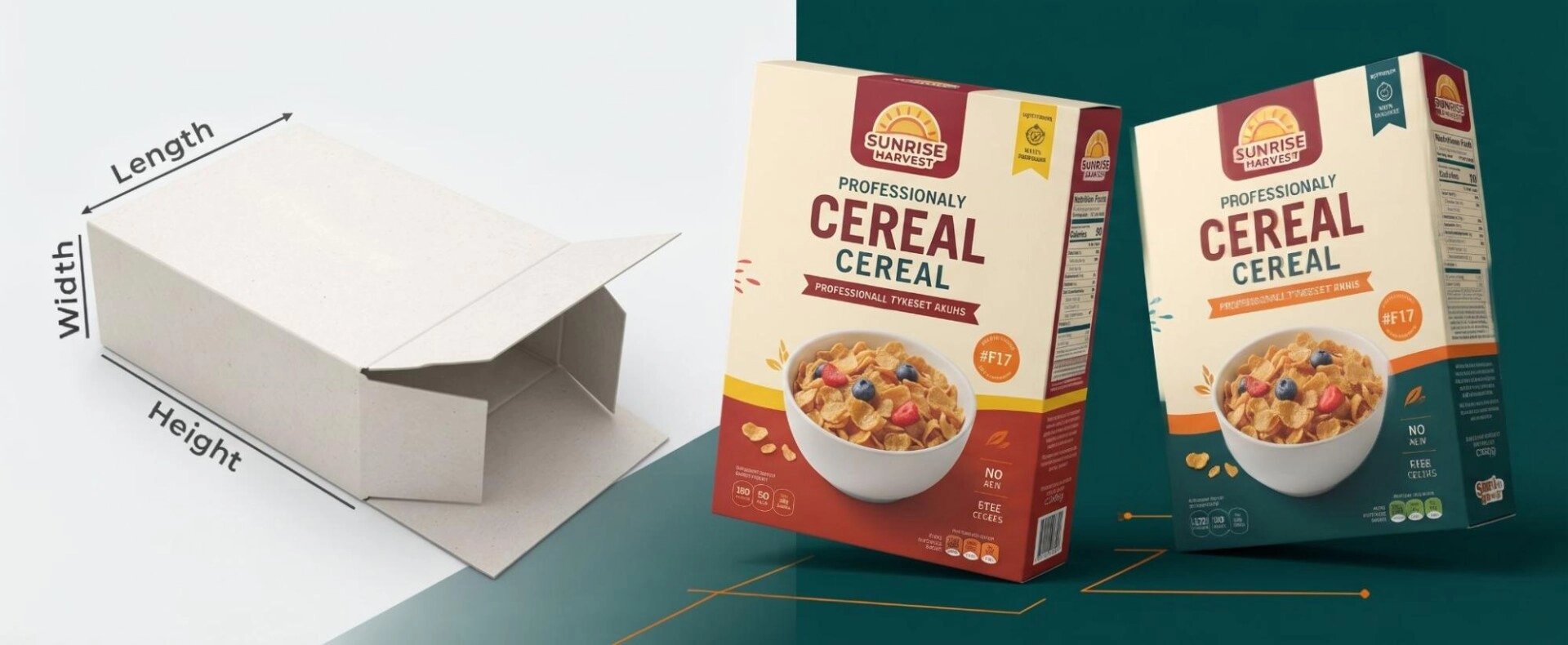
Measuring a cereal box requires a ruler, measuring tape, or digital caliper. Use a complete, undamaged box placed on a flat surface.
Step 1: Close the Box Properly
Make sure the top and bottom flaps are fully closed. Open or raised flaps can produce an inaccurate height. If possible, measure a filled box. An empty carton may bend or collapse slightly.
Step 2: Measure the Length
Place the ruler across the front panel from the left edge to the right edge. Keep it level and record the distance between the outer edges.
Example:
Length: 7.5 inches
Step 3: Measure the Width
Measure the side panel from the front edge to the back edge. Do not measure diagonally or around the box.
Example:
Width: 2.25 inches
Step 4: Measure the Height
Position the box upright. Measure from the bottom surface to the top edge of the closed carton.
Example:
Height: 11.5 inches
Step 5: Record the Complete Size
Write the measurements in the correct order:
7.5 × 2.25 × 11.5 inches
You can also convert the dimensions into millimeters:
- 7.5 inches = 190.5 mm
- 2.25 inches = 57.15 mm
- 11.5 inches = 292.1 mm
The metric dimensions are approximately:
191 × 57 × 292 mm
State when measurements have been rounded.
Internal vs External Cereal Box Dimensions
Cereal packaging has both internal and external dimensions. The correct choice depends on what you are trying to calculate.
Internal Dimensions
Internal dimensions describe the usable space inside the carton. They are important when determining:
- Inner bag fit
- Cereal volume
- Required product clearance
- Insert dimensions
- Filling and packing needs
External Dimensions
External dimensions describe the box’s complete outside size. They help with:
- Retail shelf planning
- Shipping case development
- Display arrangements
- Warehouse storage
- Pallet calculations
A box measuring 7.5 × 2.25 × 11.5 inches externally will have slightly smaller internal dimensions because the paperboard panels occupy space.
Finished Size vs Dieline Size
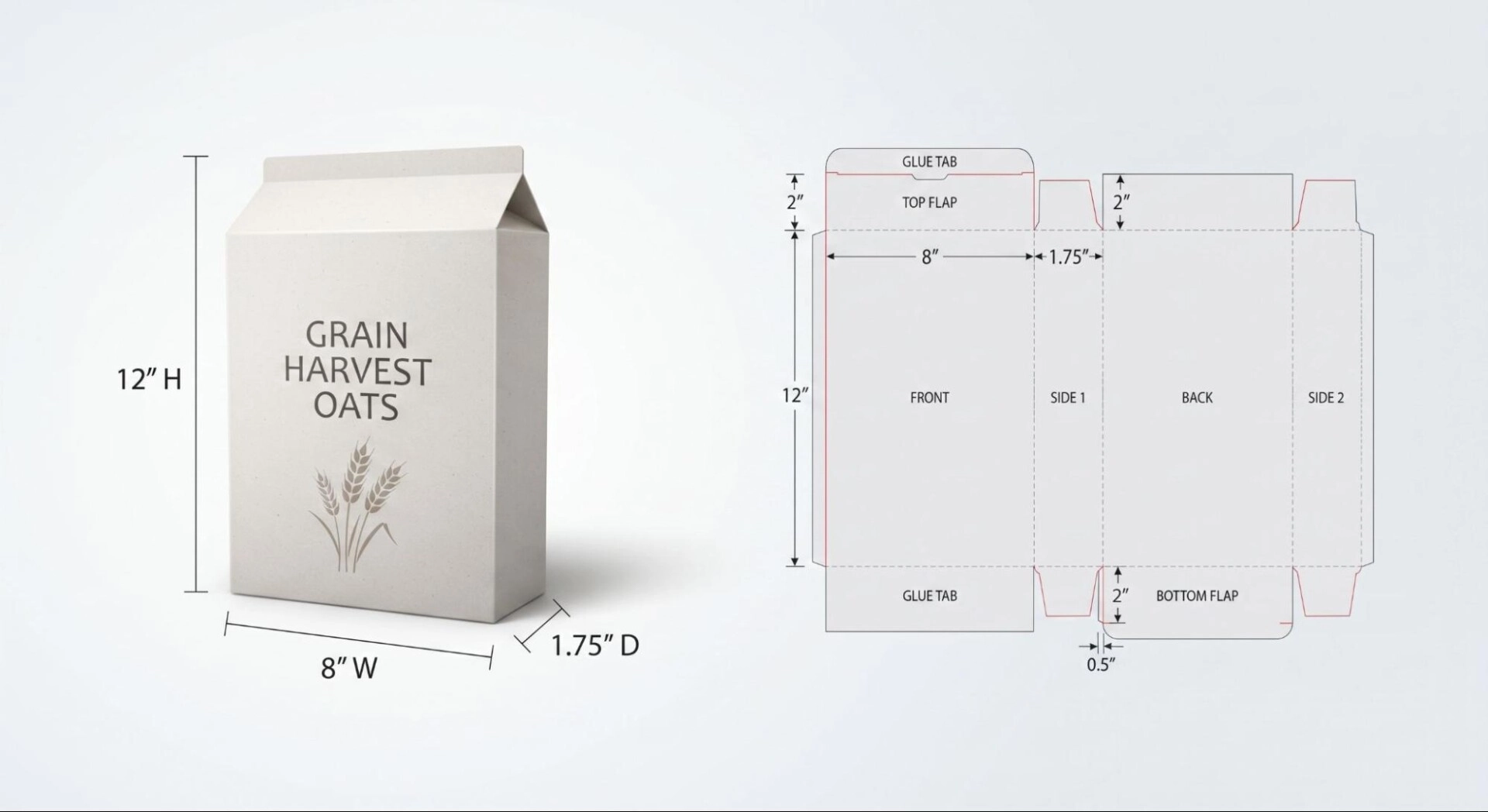
The finished size describes the assembled cereal box. The dieline represents the complete flat layout before folding and gluing.
A dieline includes:
- Front panel
- Back panel
- Two side panels
- Glue flap
- Top flaps
- Bottom flaps
- Fold lines
- Cut lines
- Bleed area
How to Calculate Cereal Box Volume
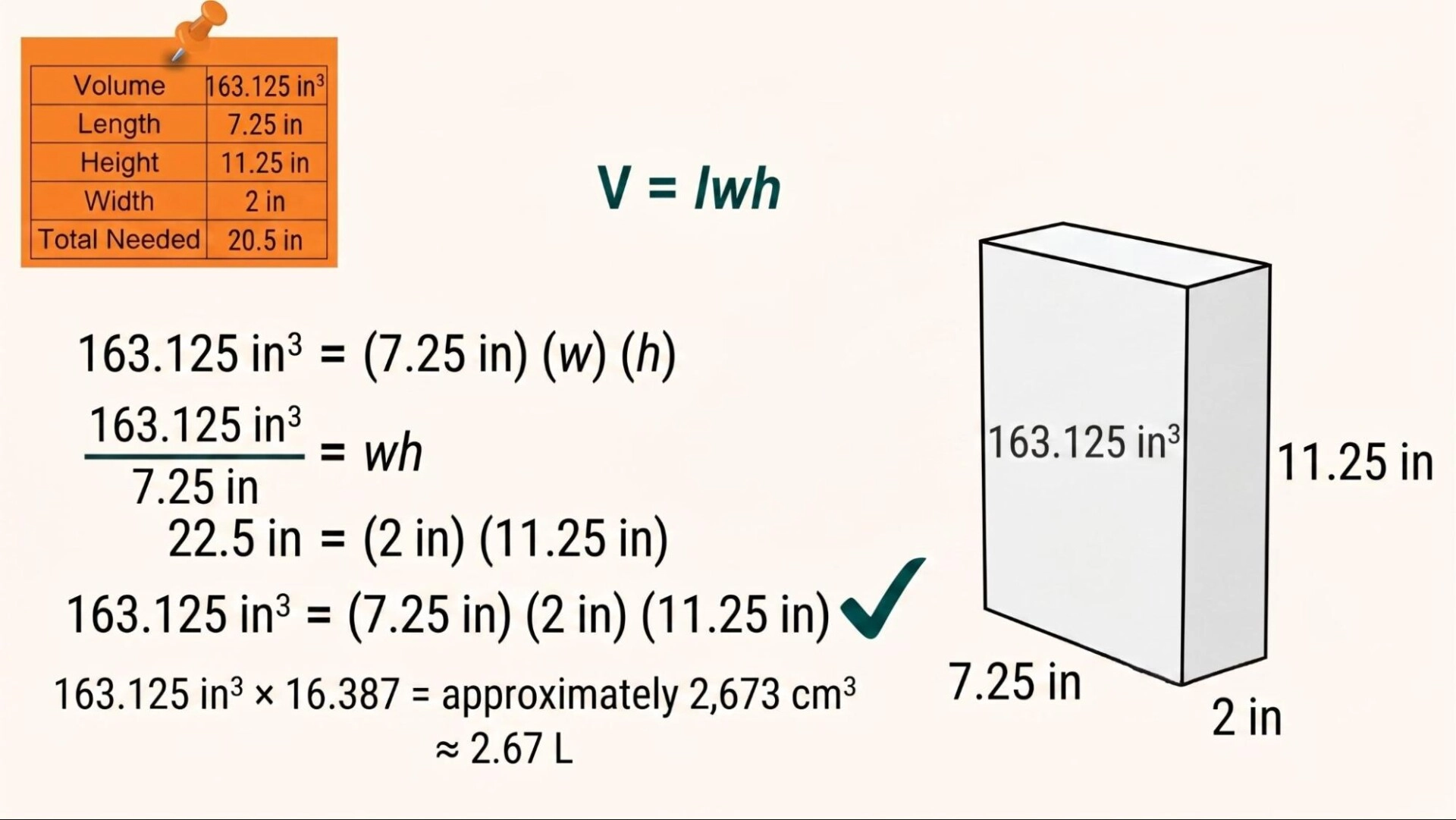
Use the rectangular volume formula:
Volume = Length × Width × Height
Suppose a cereal box has internal dimensions of:
7.25 × 2 × 11.25 inches
Calculate the internal volume:
7.25 × 2 × 11.25 = 163.125 cubic inches
This result represents the approximate geometric volume of the carton.
To convert cubic inches into cubic centimeters, multiply by 16.387:
163.125 × 16.387 = approximately 2,673 cubic centimeters
Because 1,000 cubic centimeters equals one liter, the internal volume is approximately:
2.67 liters
This does not mean the box holds 2.67 liters of solid cereal without empty space. Cereal pieces create air gaps, and the sealed inner bag also requires space.
How Much Empty Space Should a Cereal Boxes Have?
A cereal boxes needs enough space to hold the filled inner bag without excessive pressure. However, too much empty space can waste material and disappoint customers.
Some space may be needed for:
- Inner bag sealing
- Product settling
- Packing tolerances
- Cereal movement
- Closing the carton
- Protecting fragile pieces
The box should not crush the filled bag. It also should not allow the bag to shift excessively.
For example, if a filled inner bag measures 7 × 2 × 10.75 inches, a starting internal carton size might be:
7.25 × 2.25 × 11 inches
This example provides limited clearance on the sides and top. The final allowance should be tested because flexible bags change shape after filling.
Measuring Mini Cereal Boxes
When several mini boxes are sold together, measure the complete arrangement before designing the multipack.
| Dimension | Example Value |
| Length | 3.5 inches |
| Width | 1.5 inches |
| Height | 5.5 inches |
| Common Uses | Hotels, schools, cafeterias, variety packs, promotions |
Measuring Family-Size Cereal Boxes
The family-size box provides substantially more space. However, external volume does not directly indicate net cereal weight.
| Box Type | Dimensions (L × W × H) | Approx. External Volume |
| Regular retail box | 7.5 × 2.25 × 11.5 inches | 194.06 cubic inches |
| Family-size box | 9 × 3 × 14 inches | 378 cubic inches |
Cereal Box Dimensions for Retail Shelves
Retail shelf planning should consider more than box height. The complete shelf footprint and front-facing area affect product placement.
| Planning Factor | Description |
| Box height | Vertical clearance needed on the shelf |
| Front panel length | Determines facing width |
| Side depth | Affects how far back the box sits |
| Number of facings | How many boxes shown side by side |
| Shelf width | Total horizontal space available |
| Shelf depth | Total space from front to back |
| Clearance above box | Space needed above for stocking/removal |
Cereal Box Dimensions for Shipping Cases
After measuring the individual cartons, determine their arrangement inside the corrugated shipping case.
Measurements must be recorded separately for every packaging level.
For example:
| Packaging Level | Example Dimensions | Main Purpose |
| Individual milk carton | 75 × 72 × 195 mm | Holds the milk |
| Six-carton multipack | 230 × 150 × 200 mm | Groups retail units |
| Shipping case | 470 × 310 × 215 mm | Protects multiple packs |
| Pallet load | Based on case arrangement | Storage and transportation |
Paperboard Thickness and Finished Dimensions
Cereal cartons are commonly made from folding paperboard. The selected material influences strength, printing, folding, and final dimensions.
Material selection depends on:
- Cereal quantity
- Box size
- Required stiffness
- Retail handling
- Printing needs
- Sustainability goals
- Distribution conditions
A larger cereal box may need thicker or stronger paperboard to prevent panel bulging. However, excessive thickness can make folding difficult and increase material use.
Common Cereal Box Measurement Mistakes
Here are some mistakes that should be avoided while measuring cereal boxes.
Measuring Open Flaps
The box height should be measured when the top and bottom closures are properly closed.
Using the Wrong Dimension Order
Record the size as Length × Width × Height and label each value clearly.
Confusing Internal and External Sizes
Internal dimensions determine product fit. External dimensions support shelf, shipping, and storage planning.
Measuring a Crushed Carton
Bent panels can reduce the recorded width or depth. Use an undamaged production sample.
Estimating Size From Net Weight
Cereal density varies. Weight alone cannot provide accurate box dimensions.
Measuring an Empty Inner Bag
The filled bag can be much thicker and shorter than the flat empty bag. Measure it after filling and sealing.
Ignoring Paperboard Thickness
Material thickness affects the usable internal space and the final external size.
Creating Artwork Without a Dieline
Finished box dimensions do not include glue flaps, closure panels, bleed, or fold positions.
Rounding Too Early
Repeated rounding can create errors when several boxes are arranged inside one case or across a pallet.
Cereal Box Dimension Checklist
Before approving the final size, confirm the following:
- Product weight has been finalized
- Cereal density has been tested
- Filled inner bag has been measured
- Internal length is sufficient
- Internal width allows bag expansion
- Internal height provides sealing clearance
- External dimensions fit the retail shelf
- Front panel supports the required design
- Paperboard strength is suitable
- Cartons fit the shipping case
- Case dimensions support efficient pallet loading
- Physical prototypes have been tested
- Final artwork uses the approved dieline
Get the Perfect Cereal Box Dimensions for Your Product
To get correct measurements for a cereal box, measure the length, width, and height while the box is fully assembled and closed. Keep in mind that things like cereal weight, product density, the size of the inner bag, board thickness, and shelf space requirements, all can affect the final result. Calculations are a good starting point, but you should always test a filled sample and a physical prototype before moving into the next phase.
Frequently Asked Questions
A standard retail cereal box is commonly around 10 to 13 inches tall. Exact dimensions depend on brand, cereal type, product weight, and package format.
Mostly cereal boxes are 7 to 8 inches long, 2 to 3 inches wide, and 11 to 13 inches high.
No. every box have different heights. Products with the same net weight may also use different box dimensions.
No. The same box volume can hold different weights depending on the cereal’s shape and density.
For new packaging, fill and seal the inner bag first. Measure its maximum dimensions and develop the carton around that filled bag.