












Related Products
$10.00 Original price was: $10.00.$5.00Current price is: $5.00.
In Stock

$0.50 Original price was: $0.50.$0.10Current price is: $0.10.
In Stock

$0.50 Original price was: $0.50.$0.10Current price is: $0.10.
In Stock
$10.00 Original price was: $10.00.$5.00Current price is: $5.00.
In Stock
Table of Contents
Get A Free Quote
Corrugated boxes are printed five main ways: flexo post-print, flexo pre-print, litho lamination, litho labels and digital inkjet. Here’s the surprising part. The sharpest graphics on corrugated packaging usually never touch the fluted board at all. They’re printed on flat paper first, then glued on top.
That matters because corrugated board isn’t flat. A wavy layer of fluting sits under the outer liner. Every press has to deal with it in its own way. The method you pick changes how sharp your logo looks, how many colors you get, what you pay to set up and how many boxes it makes sense to order.
A plain shipping box with a one color logo and a retail display box with a product photo need very different presses. This guide covers corrugated only. For offset, digital and flexo across all box types, see our guide to popular printing methods for custom boxes. If you’re new to how the board itself is built, start with what custom corrugated boxes are.
Corrugated Printing Methods At A Glance
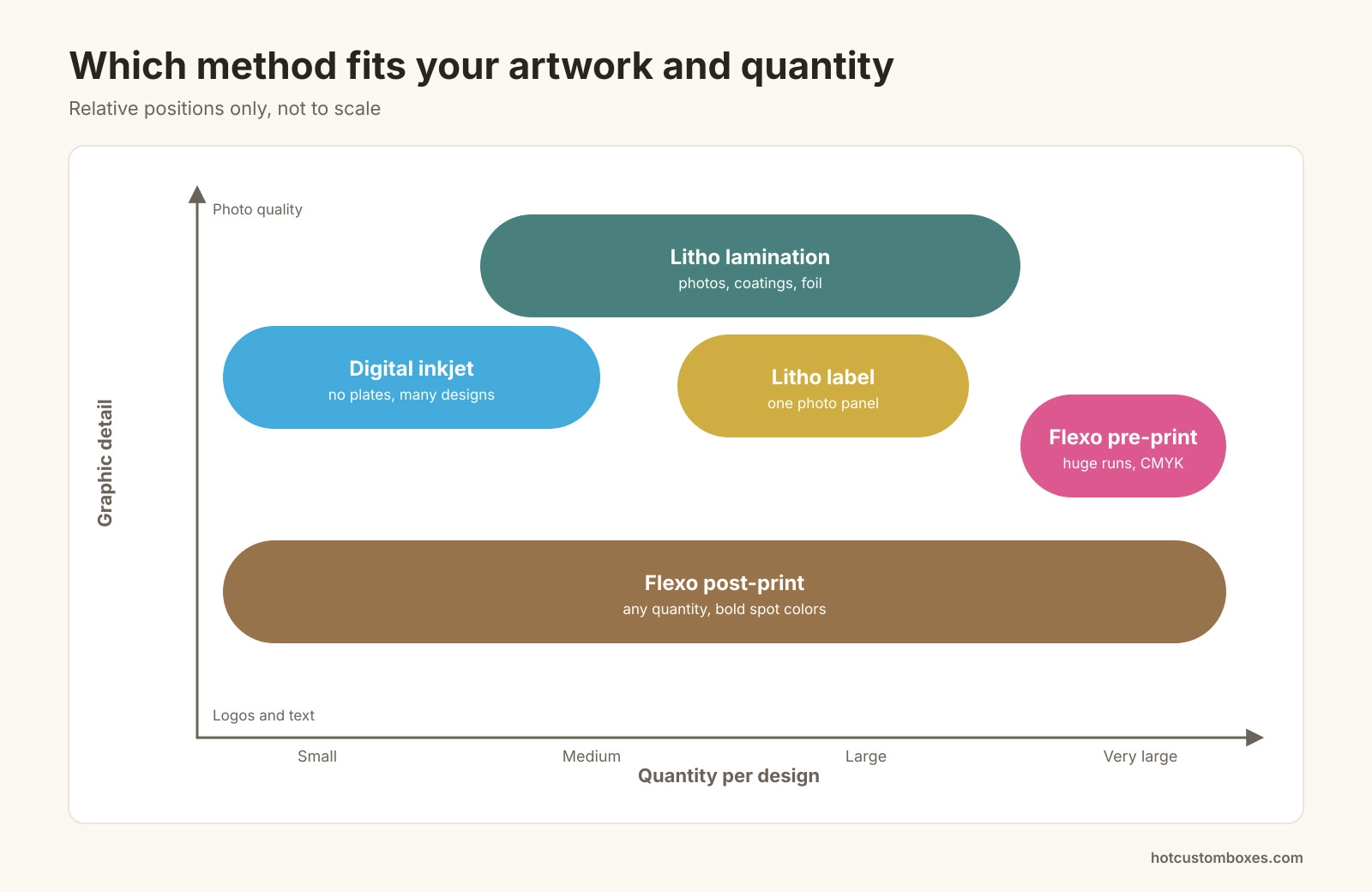
Flexo post-print handles most plain shipping boxes, litho lamination gives photo quality and digital inkjet suits small runs with no plates.
| Method | How it works | Colors and detail | Quantities it suits | Best for |
|---|---|---|---|---|
| Flexo post-print (direct print) | Plates print water-based ink straight onto finished board | 1 to 7 colors in one pass. Low to medium detail. | Any quantity, lowest cost per box on long runs | Shipping boxes, logos, text, bold spot colors |
| Flexo pre-print | The liner roll is printed before it’s corrugated | CMYK plus up to 3 spot colors. Medium to high detail. | Very high volumes only | Large retail and ecommerce programs |
| Litho lamination | An offset printed sheet is laminated onto singleface corrugated | Up to 7 colors plus coatings and foil. High detail. | Small to large runs | Retail boxes, displays, product photos |
| Litho label | An offset printed label is glued onto combined board | High detail on the labelled panel only | Medium runs | One high impact panel on a plain box |
| Digital inkjet | Printheads spray CMYK ink with no plates | Medium to high detail. Narrower color range than litho. | Short runs, often 1 to a few thousand boxes | Short runs, many designs, test launches |
Color counts and detail ratings come from Packaging Corporation of America’s print types guide. Screen printing also exists, but box plants rarely use it on corrugated outside very small runs of one or two colors.
Flexo Post-Print Puts Ink Straight Onto Finished Board
Flexo post-print, also called direct print, is the most common way to print corrugated boxes and the cheapest per box once runs get long.
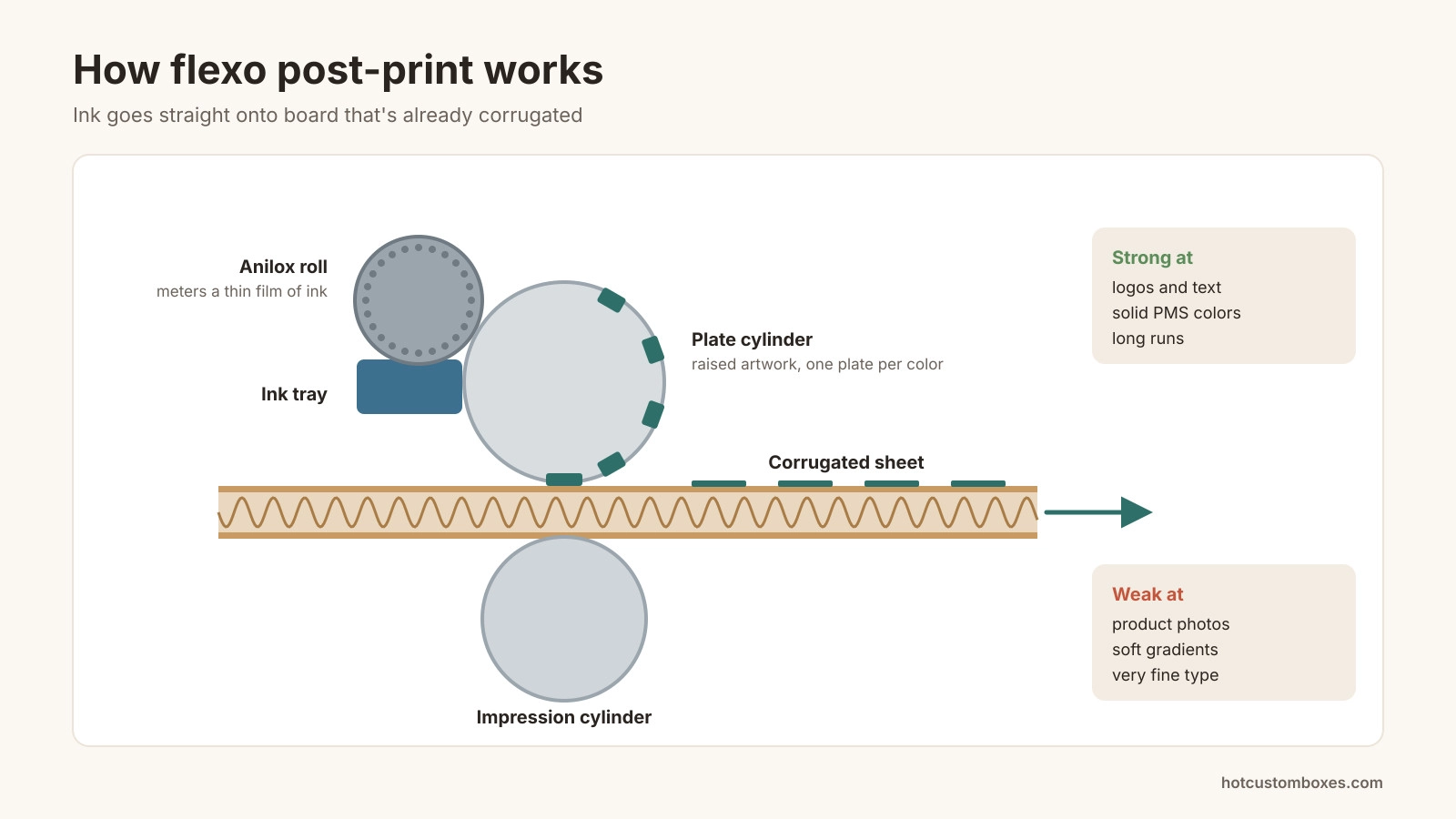
It works like a very precise rubber stamp. Each color gets its own flexible plate made of rubber or photopolymer, with the artwork raised on its surface. An anilox roll, covered in tiny engraved cells, feeds a thin, even film of ink onto the plate. The plate then presses that ink onto the outer liner of board that’s already been corrugated. Corrugated plants mostly run water-based inks for this.
Because the box is printed after it’s built, many plants print, slot and fold in one pass on a flexo folder-gluer. That’s a big reason flexo stays so economical for shipping boxes.
Where it’s strong: logos, text, handling symbols and solid spot colors. A PMS (Pantone) color printed as one solid ink looks deeper and more even than the same shade built from CMYK dots.
Where it struggles: product photos, soft gradients and very fine type. Each color plate has to line up with the others. Small shifts in registration blur multi-color images. The flutes under the liner can also show through as stripes, which we explain below.
A kraft shipping box with a two color logo, an address panel and a “this side up” arrow is a textbook post-print job.
Flexo Pre-Print Prints The Liner Before The Board Is Made
Flexo pre-print prints a roll of linerboard first and corrugates it afterward, so the flutes never get a chance to distort the image.
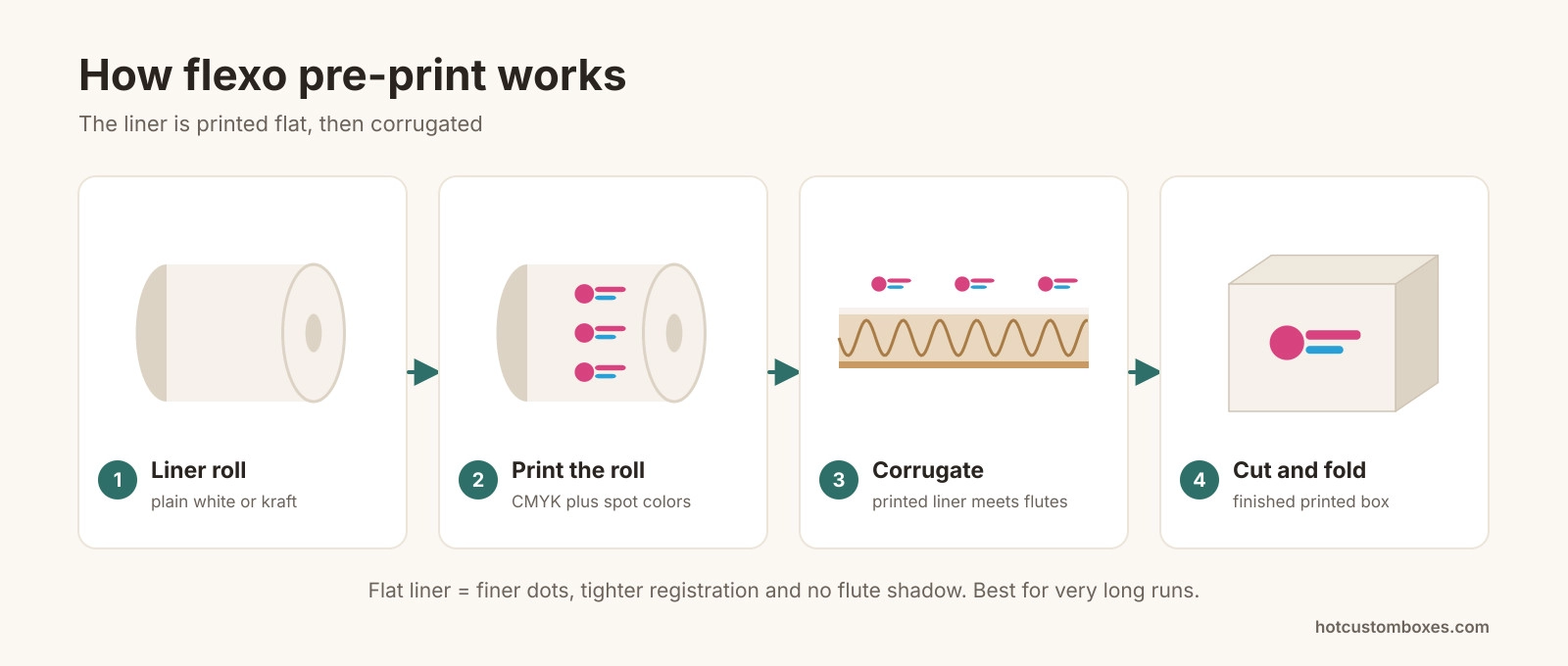
The printed roll runs through the corrugator, where it’s glued to the fluted medium like any plain liner. Since the liner is still flat and smooth when it’s printed, the press can hold finer dots and tighter registration. DS Smith lists the gains as more accurate color balance, no flute shadow and the option to use lighter liners. Packaging Corporation of America describes four-color process (CMYK) plus up to three spot colors in one pass. The outside liner, the inside liner or both can be printed this way.
The catch is volume. Linerboard for pre-print is bought as roll stock. How to Buy Packaging puts a typical roll at about a ton. Plates, press time and corrugator scheduling all have to be paid back across a very long run.
Good fit: a national brand shipping the same full-color ecommerce box by the hundreds of thousands.
Poor fit: a first order, a seasonal design or any job where the artwork might change next quarter.
Litho Lamination And Litho Labels Give Corrugated Photo Quality
Litho lamination prints the artwork on flat paper with an offset press, then glues that sheet onto corrugated board to become its outer face.
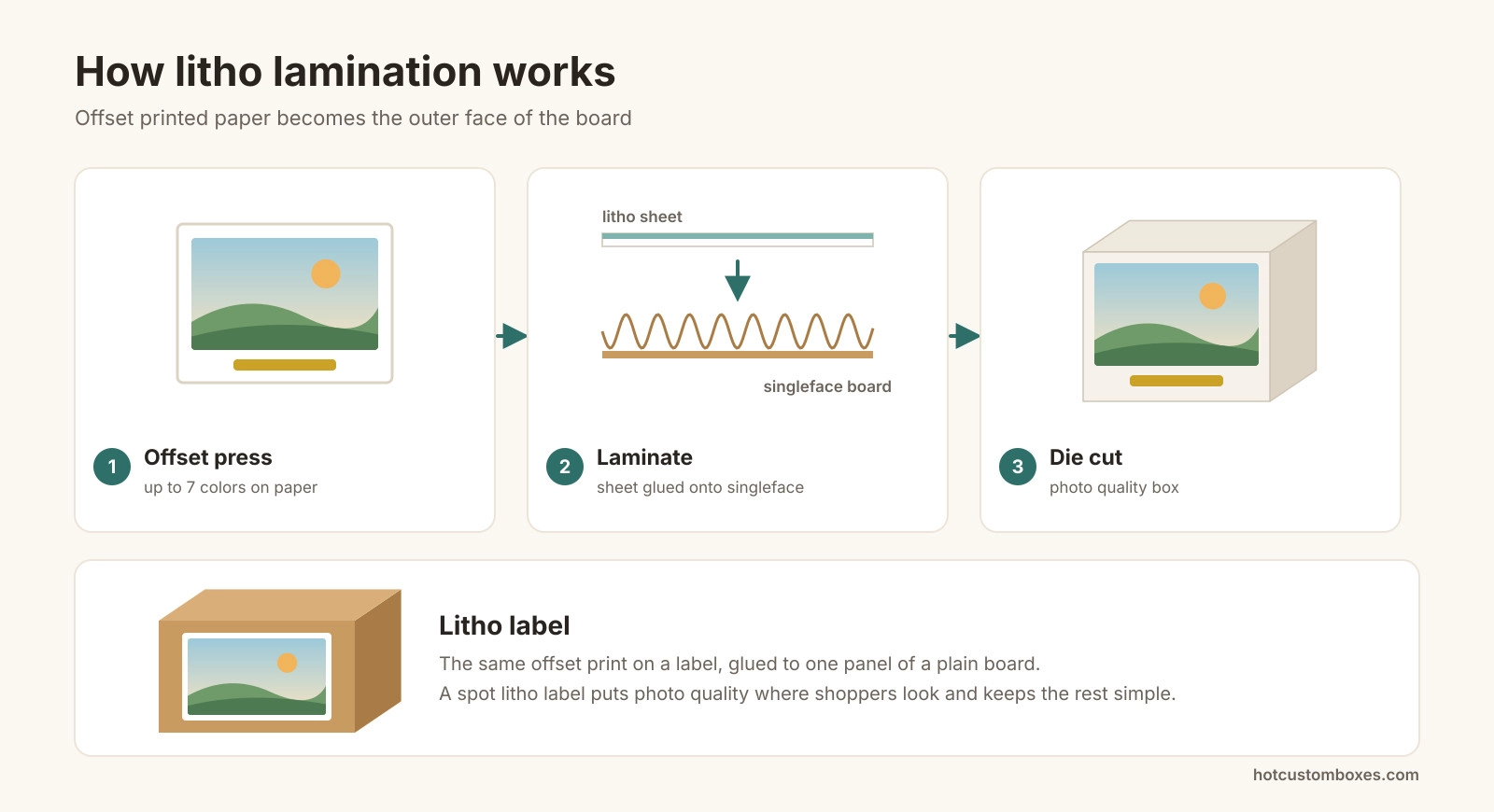
Offset lithography needs a smooth, flat sheet to print well. Corrugated board is neither. So the printing happens on paper first. The press runs the sheet, the plant laminates it onto singleface corrugated (a liner with flutes glued to one side) and the result is die cut into boxes. Packaging Corporation of America lists up to seven colors in one pass, aqueous and UV coatings and foil stamping as options. Finishes such as matte or gloss lamination, spot UV and embossing work well here too, because they’re applied to the paper rather than the rough board.
One point trips people up. Litho lamination isn’t just another word for offset printing. Offset is the press. Lamination is the extra step that puts the offset print onto corrugated.
Litho labels use the same offset print, but on a label that’s glued onto combined board after it’s corrugated. A popular way to save money is a spot litho label: one photo-quality panel on the front, with plain flexo print or no print on the other sides.
Every color still needs its own plate. The lamination step also adds time. Lock your artwork before you approve the proof, since a change after plates are made means new plates.
A candle gift box with a full-bleed product photo and a gold foil logo is a classic litho laminated job.
Digital Inkjet Prints Corrugated With No Plates At All
Digital inkjet sprays CMYK ink from printheads straight from your file, so there are no plates to make and each box can carry different artwork.
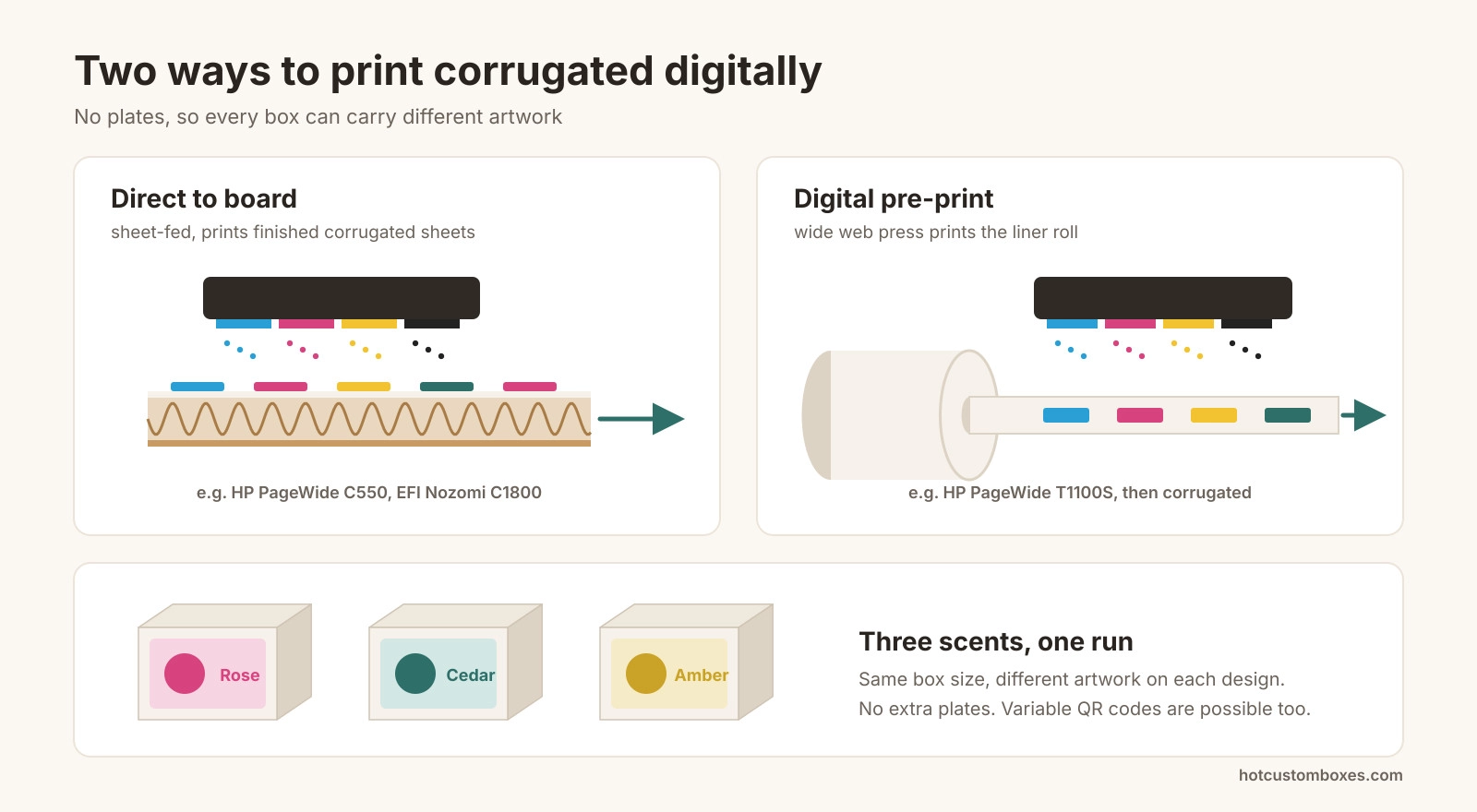
There are two kinds. Most guides only mention one.
- Direct to board (post-print): sheet-fed presses print finished corrugated sheets, which are then die cut. HP’s PageWide C550 and EFI’s Nozomi C1800 are two well-known examples. International Paper says typical digital runs on its sheets are 1 to 4,000 boxes.
- Digital pre-print: wide web presses such as HP’s PageWide T1100S print the liner roll before corrugating, like flexo pre-print but without plates. This is a big-plant option for long runs that still need frequent design changes.
Where it’s strong: short runs, test launches, seasonal designs and several SKUs in one order. Two scents can share one box size with different artwork, with no extra plates. Variable data, such as a unique QR code or name on every box, is also possible.
Where it struggles: International Paper’s own sell sheet lists the limits plainly. Digital ink costs more than flexo ink, so the cost per box doesn’t fall much on long runs. The color range is narrower than litho labels, so images can look a little less vivid. Tape can grip heavily inked areas unevenly. Small or reversed text needs extra care.
Print quality keeps improving each year, so ask for a printed sample of your own art on your chosen board before you judge it.
The Board Itself Changes How Your Print Looks
Flute size, liner color and liner coating change the final print almost as much as the press, so choose the board and the method together.
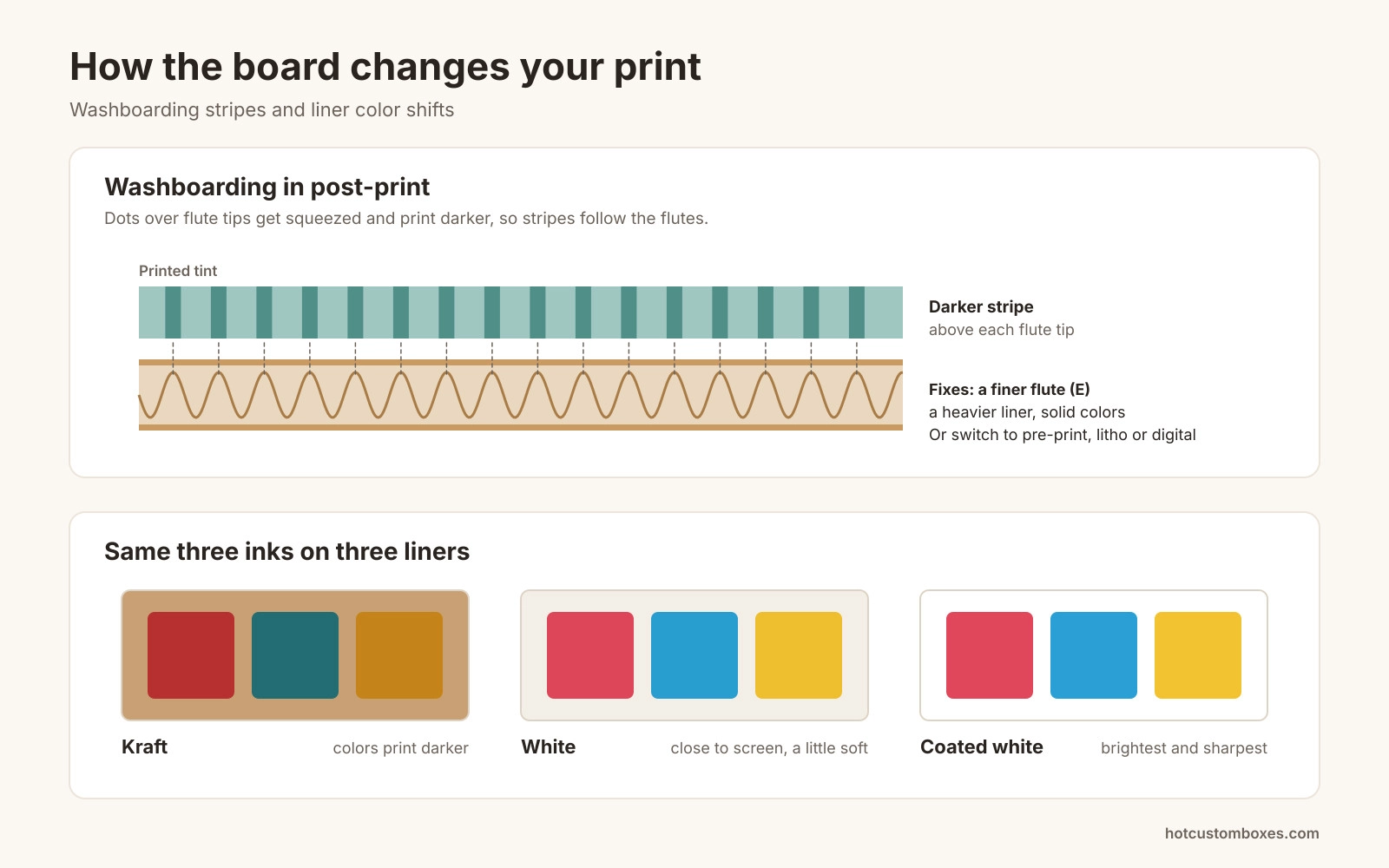
Washboarding Causes The Stripes On Printed Boxes
Washboarding, also called fluting, is the pattern of light and dark stripes that runs along the flutes on some direct printed boxes. In post-print, the plate meets board that has hard flute tips and softer valleys under the liner. Ink dots over the tips get squeezed wider and print darker.
Dots over the valleys don’t, so stripes appear. Coarse flutes and thin liners make it worse.
Light tints, soft gradients and big pale areas show it most. Solid colors and text hide it well. You can reduce it by:
- Printing on a finer flute. E flute is roughly 1.2 to 1.8 mm (about 1/16 in) thick and much smoother than C flute. Our corrugated flute guide compares every size.
- Using double wall board with the fine flute on the outside, such as EB, when you need strength and a cleaner print face.
- Asking for a heavier outer liner.
- Moving to pre-print, litho lamination or digital for photo-heavy art.
Plate makers such as MacDermid and Flint Group also sell flat-top dot plates designed to cut fluting in post-print, so it’s worth asking what your box plant uses.
Kraft And White Liners Print Color Differently
| Outer liner | What happens to your colors | What to do |
|---|---|---|
| Kraft (brown) | Standard process inks are see-through, so the brown shows through. Colors print darker and pale shades can nearly vanish. | Use dark, solid colors. Don’t rely on white artwork, since unprinted white areas show as brown. |
| White (uncoated) | A thin bleached layer sits over brown fiber. Colors look closer to your screen but a little soft. | Fine for most full-color flexo and digital. |
| Coated white | A smooth, clay-coated face holds ink on the surface. | Use for bright color and fine detail. Litho sheets are usually coated paper. |
If you love the kraft look but need bright color, a white board printed with a kraft-style pattern is one route. Another is to keep the kraft board and print only black or one deep spot color.
Inside Printing Adds A Second Printed Face
Inside printing puts ink on the inner liner too. Quotes usually write it as two numbers, such as 4/1 or 4/4.
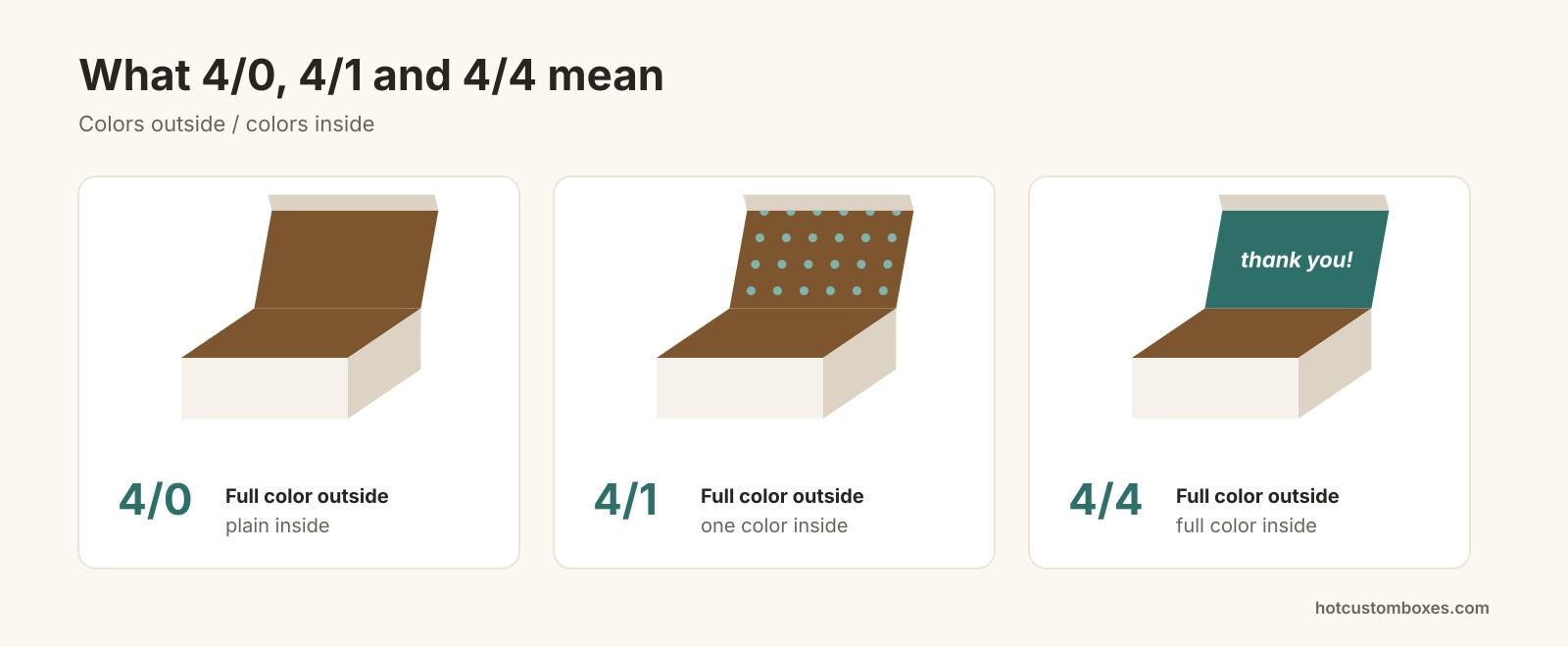
The first number is the colors outside. The second is the colors inside. So 4/0 is full color outside with a blank inside, 4/1 adds one inside color and 4/4 is full color on both faces. Box plants handle it in a few ways: pre-printing both liners before corrugating, two-sided flexo on finished sheets or a second digital pass.
Inside print pays off most on boxes people open with care. A mailer box shows its whole inner lid the moment it opens, so a one color pattern or a short thank you note gets seen. A plain shipping box that’s slit open with a knife rarely needs it.
A few practical points:
- The inside liner is often kraft even when the outside is white. Plan inside colors for brown board unless you ask for white on both faces.
- Keep inside art clear of the glue flap and anywhere tape or labels will go.
- Instructions, care tips and a QR code linking to a setup video are useful inside prints that can replace a loose paper insert.
Choosing A Printing Method For Your Corrugated Boxes
Start with your artwork and quantity: bold logos favor flexo, photos favor litho lamination and small or mixed runs favor digital.
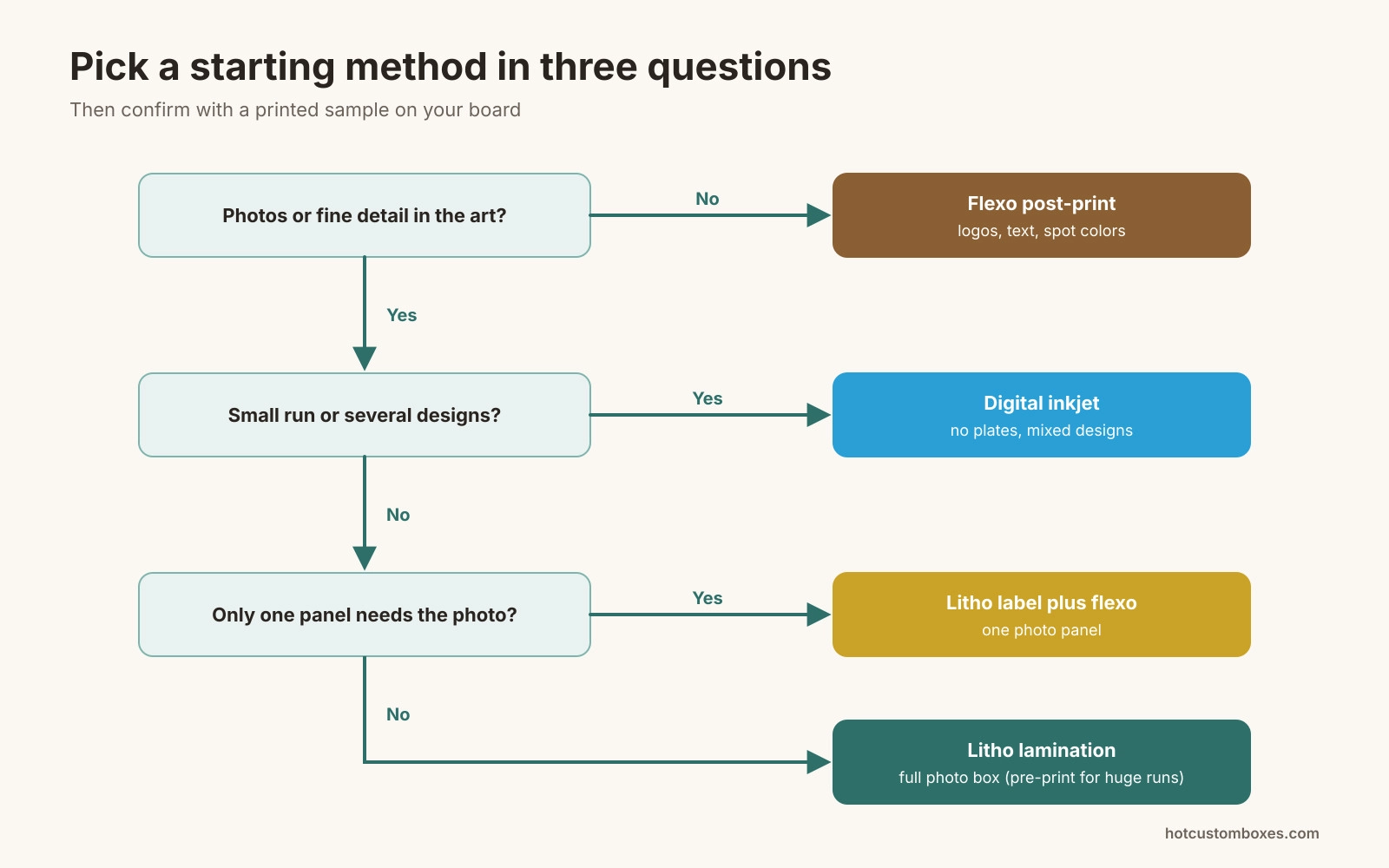
| Your box | Artwork | Quantity | Start with |
|---|---|---|---|
| Shipping box | Logo, text, 1 to 3 solid colors | Any | Flexo post-print on kraft or white |
| Ecommerce mailer | Full color, several designs | Small to medium | Digital on white board |
| Retail box or display | Product photos, foil, spot UV | Medium to large | Litho lamination |
| Plain shipper with one hero panel | One photo panel | Medium | Litho label plus flexo |
| National program | Full color, same design for years | Very large | Flexo or digital pre-print |
Worked example
A candle brand needs 300 mailers: 100 each for three scents, with a product photo on every lid.
- Flexo post-print would need a plate set for each scent. Photos are also its weak spot.
- Litho lamination would look great but still needs separate plates for three short runs.
- Digital on white E flute prints all three designs in one run with no plates. That’s the sensible start.
A year later the brand reorders 20,000 of its best seller. Now litho lamination becomes worth comparing, since its setup spreads across far more boxes. If it also needs 20,000 plain shipping boxes with a one color logo, flexo post-print on kraft fits those.
How Ordering Works At Hot Custom Boxes
You can order custom corrugated boxes from 50 boxes in any custom size. We print with offset, digital, flexographic and litho lamination methods, from 1 to 4 colors up to full color inside and out (4/4). Finishes include matte, gloss and soft touch lamination, spot UV, gold and silver foil, embossing, debossing, aqueous coating and varnish.
Design support is free. So are the die and printing plates. Before production you get a flat view and a 3D mockup of your artwork. Those show layout and placement. To judge color on the real board, especially kraft, ask for a physical sample. Shipping is free.
Send your quantity, artwork and board choice with your quote request and ask which method suits it. For plain shippers, see our custom shipping boxes. For a natural brown look, browse kraft boxes.
Artwork Mistakes That Spoil Corrugated Print
Many corrugated print problems start in the artwork file rather than on the press. A few size and color rules prevent the common ones.
Type And Line Minimums For Direct Print
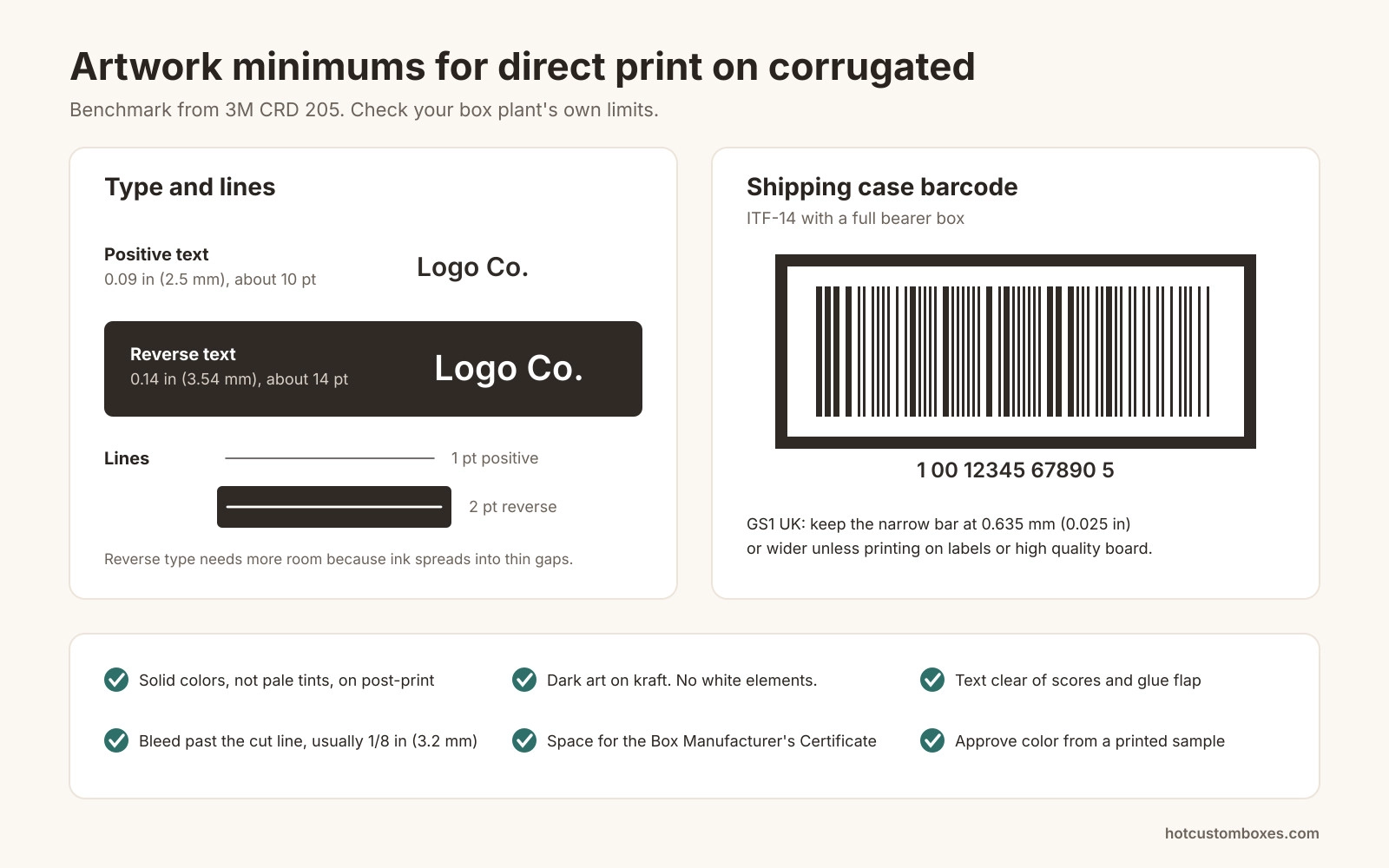
Minimum type size changes with the press, the board and the ink, so large brand owners publish their own rules. 3M’s packaging spec for direct printed corrugated (CRD 205, February 2025) is a useful benchmark:
| Element | Minimum height or width | Roughly |
|---|---|---|
| Positive text (dark on light) | 0.09 in (2.5 mm) | 10 pt Helvetica |
| Reverse text (light on dark) | 0.14 in (3.54 mm) | 14 pt Helvetica |
| Positive line or keyline | 0.014 in (0.35 mm) | 1 pt |
| Reverse line | 0.028 in (0.71 mm) | 2 pt |
Reverse type needs more room because the ink around it spreads and fills thin gaps. Ask your box plant for its own limits, since litho and digital can usually go smaller.
Six More Mistakes To Avoid
- Pale tints on post-print flexo. Large light areas show washboarding stripes. Use solid colors or switch method.
- White or pastel art on kraft. Standard inks can’t print white, so those areas stay brown. Pick a white board or redesign in dark colors.
- Retail barcodes shrunk onto rough board. For shipping cases, GS1 says the ITF-14 barcode is better suited to direct printing on corrugated. Print it with a full bearer box around it. GS1 UK advises sizes below a 0.635 mm (0.025 in) narrow bar only on labels or high quality surfaces.
- Art that ignores the dieline. Keep text away from scores and the glue flap. Extend background color past the cut line by the bleed your manufacturer asks for, usually 1/8 in (3.2 mm).
- No space for the Box Manufacturer’s Certificate. Many shipping boxes carry this stamp on a bottom flap. Leave a clear spot for it.
- Judging color on screen. A monitor glows in RGB, while board absorbs ink. Approve color from a printed sample on the real board, not from a mockup.
Match The Print Method To The Box Before You Order
The right method comes from three answers: what the artwork shows, how many boxes you need and which board the box is made from. Once those are settled, flexo, litho or digital usually picks itself.
Send us your artwork, quantity and box size. Our team will review it for the board and print method that fit. Get a Quote for your printed corrugated boxes.
Still comparing options or unsure your file is print ready? Contact Us and a packaging specialist will talk it through with you.
FAQs
Not with standard process inks, because they’re see-through and the brown board shows in any white area. Some plants offer an opaque white ink or a white underprint as an extra step. Ask about it before you design around white. The simpler route is a white board with a kraft-style pattern printed on it.
Yes, for normal shipping and shelf life. Water-based digital inks are made for corrugated and handle routine handling well. Like any ink on uncoated board, they can scuff under heavy rubbing, so presses such as HP’s PageWide C550 can add an overprint varnish. Long sun exposure in a shop window fades most inks over time.
Up to seven in one pass with flexo post-print or litho, according to Packaging Corporation of America. Digital builds most shades from CMYK. More colors raise setup on plate-based methods, so many shipping boxes use one to three spot colors. Hot Custom Boxes prints from 1 to 4 colors up to full color on both faces.
It can, slightly. Post-print presses squeeze the board as they print. Too much pressure can crush the flutes a little. Pre-print and litho lamination print before or apart from that step, which avoids it. Strength still comes mainly from the board grade and its test rating, so specify those first.
Printed corrugated is generally accepted wherever cardboard is collected. Corrugated plants mostly use water-based inks. Plastic laminates, heavy foil and wax coatings can make recycling harder. If recyclability matters for your brand, keep coverage simple and check the rules in your customers’ area.
Related Products
$10.00 Original price was: $10.00.$5.00Current price is: $5.00.
In Stock
$0.50 Original price was: $0.50.$0.10Current price is: $0.10.
In Stock
$0.50 Original price was: $0.50.$0.10Current price is: $0.10.
In Stock
$10.00 Original price was: $10.00.$5.00Current price is: $5.00.
In Stock