












Related Products
$0.50 Original price was: $0.50.$0.10Current price is: $0.10.
In Stock
$0.50 Original price was: $0.50.$0.10Current price is: $0.10.
In Stock
$0.50 Original price was: $0.50.$0.10Current price is: $0.10.
In Stock
$0.50 Original price was: $0.50.$0.10Current price is: $0.10.
In Stock
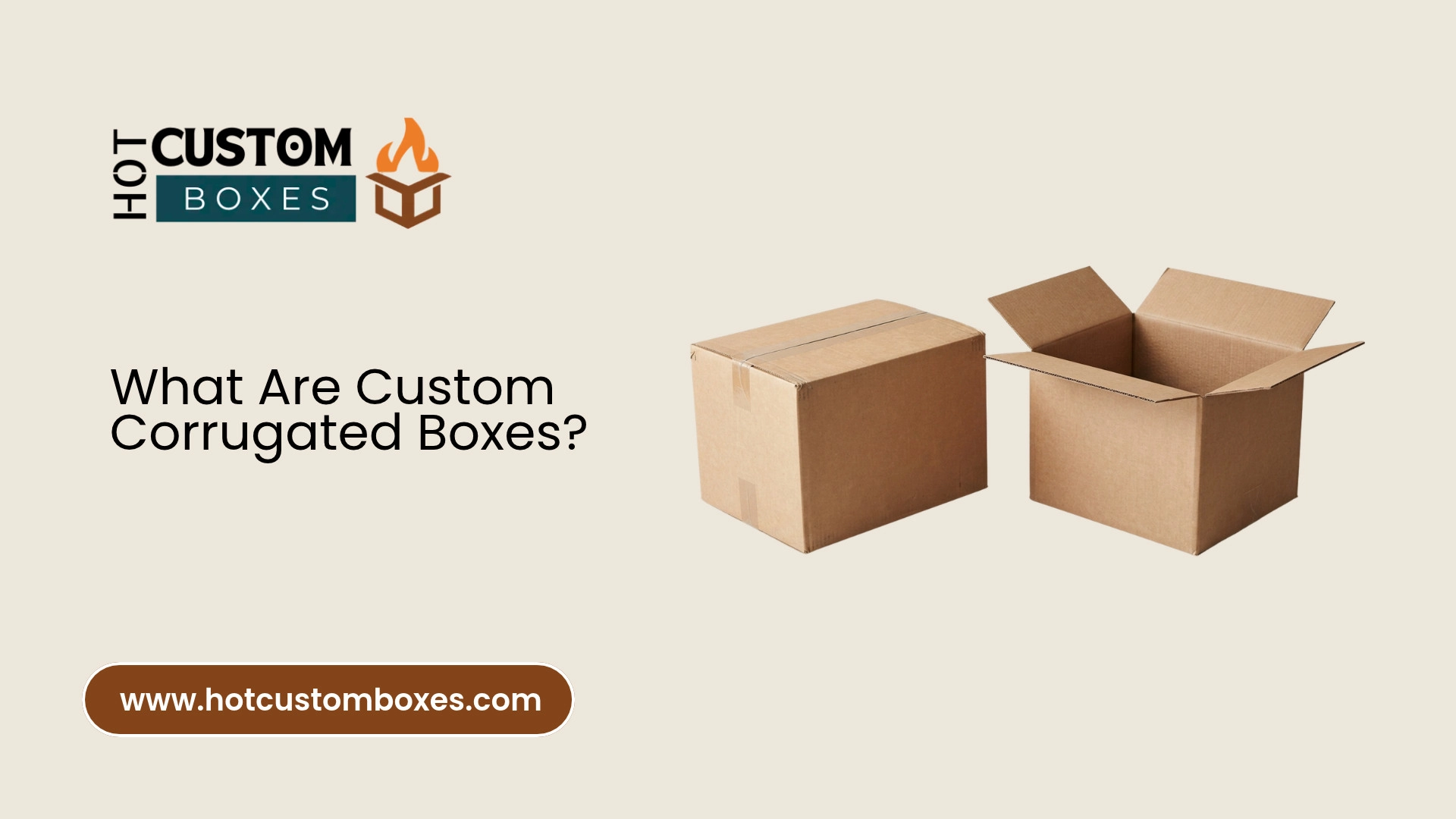
Table of Contents
Get A Free Quote
Custom corrugated boxes are boxes made from corrugated board and built to your own specs. You pick the size, the board strength, the box style and the printing. What you get is a box that fits your product, not a stock carton you have to stuff with filler.
The board itself is simple. A wavy sheet of paper called the medium sits between flat sheets called liners. Those little arches carry a lot of weight for very little material, which is why almost every parcel and pallet you’ve ever seen ships in corrugated.
Most people just call them cardboard boxes. That’s fine in everyday talk, but packaging suppliers treat the two differently. Cardboard often means a single thick sheet of paperboard, like a cereal box. Corrugated has that fluted middle layer. Our cardboard vs corrugated comparison covers the difference in detail.
By the end of this guide, you’ll know which wall type and box style to ask for. You’ll also know exactly what to send a manufacturer so your first quote comes back right.
How Is a Corrugated Board Made?
Corrugated board is made on a machine called a corrugator. It presses paper through heated, grooved rollers to form flutes, then glues flat liners to the tips of those flutes with a starch-based adhesive. Both the medium and the liners are containerboard, made from virgin kraft fiber, recycled fiber or a mix of the two. It’s usually more than 0.25 mm thick (Wikipedia).
A standard sheet has three parts:
- Outer liner. This is the face your customer sees and the surface that takes your print. Liners can be natural kraft brown, bleached white, mottled white, colored or preprinted.
- Medium (fluting). The wavy middle layer. How tall the waves are and how many fit in a foot decides the flute size: A, B, C, E or F. Thin flutes print sharper. Taller flutes cushion better. There’s a quick flute table in the next section.
- Inner liner. Closes the sandwich and adds stiffness. You can print here too if you want a message to show when the box opens.
One detail most buyers never hear about: corrugated is strongest along the direction the flutes run. That’s why manufacturers set the flutes vertically in the box walls. It’s what lets a box hold up when other boxes are stacked on top of it.

A short history
Corrugated paper began as a liner for men’s tall hats, patented in England in 1856. Albert L. Jones of New York first used it for packaging in 1871 to wrap bottles. By 1903, a cereal producer was shipping its goods in corrugated boxes (FEFCO).
What Are the Main Types of Corrugated Boxes?
The main types of corrugated boxes are single wall, double wall and triple wall. The difference is how many layers of fluting sit inside the board. More walls mean more stacking strength and puncture resistance, but also more weight and cost. There’s also single face board, which is a wrap material rather than a box.

| Type | How it’s built | Typical thickness | Best for |
|---|---|---|---|
| Single face | One medium glued to one liner. Flexible on one side. | Thin, bends easily | Wrapping bottles and furniture legs, sleeves, cushioning inside other boxes |
| Single wall | One medium between two liners | 1.2 to 4.0 mm (E, B or C flute) | Mailers, e-commerce shippers, retail boxes, most products under normal parcel handling |
| Double wall | Two mediums, three liners | 4.0 to 6.0 mm (BC or EB flute) | Heavy or fragile goods, glassware, bulk orders, boxes stacked high in warehouses |
| Triple wall | Three mediums, four liners | 6.0 to 10.0 mm | Industrial parts, machinery, bulk bins and pallet freight |
Thickness ranges are approximate and reflect the board we use at Hot Custom Boxes. Other manufacturers may run slightly different numbers for the same flute.
Flute Sizes at a Glance
The flute letter tells you how tall the waves are. Taller flutes cushion better. Shorter, tighter flutes give a smoother surface for printing.
| Flute | Approx. thickness | Flutes per foot | Common use |
|---|---|---|---|
| A | 3/16 in (4.8 mm) | 33 | Extra cushioning for fragile items |
| B | 1/8 in (3.2 mm) | 47 | Good puncture resistance. Retail shippers and displays. |
| C | 5/32 in (4.0 mm) | 39 | General shipping. The most common flute in the U.S. |
| E | 1/16 in (1.6 mm) | 90 | Printed mailers, cosmetic and retail boxes |
| F | 1/32 in (0.8 mm) | 125 | Small retail boxes and food clamshells |
These are typical U.S. industry values (Wikipedia, Packaging Corporation of America). Combined board like BC or EB pairs two flutes to make double wall. For a closer look at each one, read our corrugated flute types guide.
Here’s a simple rule. Start with single wall and only step up when something gives you a reason: the product is heavy, it’s fragile, it ships on pallets or the boxes sit in tall stacks for weeks. Plenty of brands pay for double wall they don’t need.
If you’re still deciding between corrugated and a premium presentation box, see how rigid boxes compare with corrugated.
Which Corrugated Box Styles Are Most Common?
The regular slotted container (RSC) is the most common corrugated box style. Nearly every other style is a variation on it or a die cut design built for a specific job. Box makers name these styles with a four digit code from the International Fibreboard Case Code, often called FEFCO codes. The Fibre Box Association lists the core ones in its Box Styles Basics guide.
| Style | Code | How it closes | Good for |
|---|---|---|---|
| Regular slotted container (RSC) | 0201 | All flaps are the same length. Outer flaps meet in the center. | General shipping, storage, moving. Low waste and low cost. |
| Half slotted container (HSC) | 0200 | An RSC with no top flaps | Open trays, bins or a base under a separate lid |
| Full overlap container (FOL) | 0203 | Outer flaps overlap across the full width | Heavy items and rough handling. The double flap layer protects the bottom. |
| Full telescope box | 0301 | Separate top and bottom slide over each other | Large flat items, garments, gift sets. See our corrugated boxes with lids. |
| Five panel folder | 0410 | One piece wraps around, the fifth panel closes it | Long, thin products like frames, rods or posters |
| Roll end tray with locking cover | 0427 | One die cut piece. The lid tucks and locks into the front. | The classic mailer box for e-commerce, subscriptions and PR kits |
| Pre-glued auto bottom | 0711 | Bottom snaps into place when you open the box | High packing volumes where speed on the line matters |
| Partitions | 09 series | Dividers that create one cell per item | Bottles, jars and anything that can’t touch its neighbor |
Here’s a tip that saves time. Names change from supplier to supplier, so one company’s “shipper” is another’s “mailer”. The code doesn’t change. Put the FEFCO number on your quote request and you’ll get the style you meant.
Displays are their own family. Shelf-ready trays and counter displays are usually custom die cut corrugated. Our overview of point of sale display packaging walks through those formats.

What Features Make Corrugated Boxes Worth Using?
Corrugated boxes give you a lot of strength for their weight, a strength rating you can check, a good surface for branding and a material most of North America already recycles. Here’s what each of those means when you’re ordering.
Strength you can verify
Corrugated strength is measured, not guessed. Two lab tests matter most:
- Edge Crush Test (ECT). Measures how much force the board takes on its edge before it crushes, in pounds per inch. It predicts stacking strength.
- Mullen burst test. Measures the pressure needed to rupture the board wall, in pounds per square inch. It’s about puncture and rough handling.
Many shipping boxes carry a printed stamp, usually round, called the Box Manufacturer’s Certificate. The Fibre Box Association describes it as a statement that confirms the box meets carrier construction rules and names the company that made it (Fibre Box Handbook glossary). On the stamp you’ll find the wall type, the strength rating and the size and weight limits. Most stamps show either an ECT rating or a Mullen rating. On everyday single wall shippers, 32 ECT is one of the most common grades.
A print surface that fits your brand
Liner color changes how your artwork looks. On a white liner, colors print bright and true. On natural kraft, the brown shows through, so colors come out deeper and more muted. Some brands love that earthy look. Others get surprised by it, so ask for a proof on the actual liner.
The printing method depends mostly on order size and artwork:
- Flexographic printing works well for simple logos in one to three colors, especially on larger runs.
- Digital printing handles full color with no plates, which suits short runs and frequent design changes.
- Litho lamination prints your artwork on a thin paper sheet first, then glues it onto the corrugated board. It’s the route to photo quality images on a shipping box.
At Hot Custom Boxes we print corrugated with offset, digital, flexo and litho lamination. Finishes include matte, gloss and soft touch lamination, spot UV, gold and silver foil, embossing, debossing and aqueous coating. For a simple comparison of the main presses, read offset vs digital vs flexo printing.
Light weight that keeps shipping costs down
Corrugated weighs very little for the protection it gives. That still won’t save you money if the box is too big, because UPS, FedEx and USPS bill many parcels by their size as well as their weight. A box sized close to the product usually saves more than any change in board. Our guide on reducing shipping costs with smart packaging covers that in detail.
Protection you can tune
You’re not stuck with an empty box and bubble wrap. Corrugated inserts, partitions and die cut trays hold each item in place. That cuts breakage and makes the unboxing look tidy. See our post on custom inserts and dividers for options.
Recyclable and made with recycled fiber
Cardboard is one of the most recycled materials in the United States. The American Forest & Paper Association reports that 70% to 75% of the cardboard available for recovery was recycled in 2025, more than 33 million tons (AF&PA, August 2026). You’ll still find articles quoting rates above 90%. Those numbers came from AF&PA’s older method, which it replaced with ranges starting with its 2023 data (Packaging Dive, November 2024).
It works in the other direction too. According to the Fibre Box Association, the average corrugated box contains 52% recycled content.
One caution. Heavy plastic films and wax coatings can make a box harder to recycle. If recyclability matters to your customers, ask your manufacturer which coatings keep the box curbside friendly.
Where Are Custom Corrugated Boxes Used?
Custom corrugated boxes are used anywhere a product has to survive shipping, stacking or handling and still look good when it arrives. The scale is huge. U.S. plants made 401 billion square feet of corrugated material in 2022, enough for about 40 billion packages. The industry runs 1,145 manufacturing facilities (Fibre Box Association).
The right box changes a lot by industry:
| Industry | Box that usually fits | Why it works |
|---|---|---|
| E-commerce and DTC brands | E-commerce corrugated boxes and RSC shippers | Survive parcel networks and keep returns low |
| Subscriptions and PR kits | Subscription mailer boxes and PR boxes | Printed inside and out for an unboxing people film and share |
| Cosmetics and skincare | Corrugated cosmetic mailers in E flute | Thin board that prints sharp but still protects glass bottles |
| Apparel | Apparel mailer boxes or telescope boxes | Flat, light and easy to fold garments into |
| Food and delivery | Corrugated pizza boxes and cake boxes | Stay rigid under a hot, heavy load and stack well on delivery runs |
| Retail stores | Corrugated display boxes and shelf-ready trays | Go straight from the pallet to the shelf |
| Electronics | Double wall boxes with die cut inserts | Stop movement and absorb drops |
| Industrial and bulk freight | Triple wall boxes and bins | Carry heavy parts on pallets |
Not sure which of these matches your product? Start from how it ships. A box that goes through UPS on its own faces drops and punctures. A box riding on a pallet mostly faces weight from above. That one question narrows the choice fast.
How to Spec a Custom Corrugated Box
To get an accurate quote, send your manufacturer seven details: inside dimensions, product weight, shipping method, wall type, box style, print and quantity. Miss one and you’ll either wait on questions or get a price for the wrong box.
- Inside dimensions (L × W × H). Measure the product, then add a little room for inserts or padding. Always say whether your numbers are inside or outside sizes. Board thickness makes the two very different on double and triple wall. Our length, width and height guide explains the order.
- Weight of the packed product. One number, in pounds or kilograms.
- How it ships. Single parcels through UPS, FedEx, USPS or Canada Post? Pallets on LTL freight? Retail shelves? Each one stresses the box differently.
- Wall type and flute. If you’re not sure, say so. A good manufacturer will recommend one from the weight and shipping method.
- Box style. Name it and add the FEFCO code if you know it, like RSC 0201 or mailer 0427.
- Liner and print. Kraft or white, how many colors, printed outside only or inside too, plus any finish such as spot UV or foil.
- Quantity and deadline. Unit price drops as quantity rises, so ask for two or three price breaks.
At Hot Custom Boxes, custom corrugated orders start at 50 boxes. Design support is free. So are the die and printing plates. You’ll see a flat view and a 3D mockup before anything goes to print. If you’d like to hold one first, ask for a physical sample. Production typically takes 4 to 7 business days, with free shipping. Browse the full corrugated boxes range to see styles, colors and stock sizes.
Mistakes that cost buyers money
- Ordering by outside dimensions when the product needs a set inside space. The box arrives a few millimeters too small.
- Jumping to double wall for light products. You pay more per box and more in freight for protection you don’t use.
- A box much bigger than the product. Carriers charge for the empty space. Your product also slides around inside.
- Expecting bright, exact brand colors on kraft. Brown liner shifts every color. Ask for a white liner or a printed proof.
- Skipping a sample on a big first order. One test shipment of a real packed box can save a whole production run.
Get Corrugated Boxes Built Around Your Product
A good corrugated box starts with three choices: the wall type, the box style and the board strength. Get those right for how your product ships, then let size and print do the branding work.
If you already have your dimensions and a rough quantity, Get a Quote [add Get a Quote link] and our team will recommend a board grade and style, then send pricing with a free 3D mockup. Have a product you’re unsure how to pack? Contact us and talk it through with a packaging specialist first.
Frequently Asked Questions
Not exactly. In everyday speech people use the words the same way. In packaging, cardboard usually means a single sheet of paperboard, while corrugated has a fluted layer between liners. That fluted layer makes corrugated much stronger for shipping.
Triple wall is the strongest. It uses three fluted layers and four liners and is built for heavy industrial parts and pallet freight. Most products never need it. Single wall or double wall covers nearly all retail and e-commerce shipping.
RSC stands for regular slotted container. It’s the standard shipping box with four flaps on the top and four on the bottom. The outer flaps meet in the middle. Its international style code is 0201.
Yes. Plain corrugated is accepted by most curbside recycling programs. AF&PA reports that 70% to 75% of the cardboard available for recovery in the U.S. was recycled in 2025. Heavy plastic films and wax coatings can make recycling harder.
At Hot Custom Boxes, custom corrugated boxes start at 50 units. That makes short runs practical for product launches, samples and seasonal packaging.
Related Products
$0.50 Original price was: $0.50.$0.10Current price is: $0.10.
In Stock
$0.50 Original price was: $0.50.$0.10Current price is: $0.10.
In Stock
$0.50 Original price was: $0.50.$0.10Current price is: $0.10.
In Stock
$0.50 Original price was: $0.50.$0.10Current price is: $0.10.
In Stock