














Related Products
$10.00 Original price was: $10.00.$5.00Current price is: $5.00.
In Stock

$0.50 Original price was: $0.50.$0.10Current price is: $0.10.
In Stock

$0.50 Original price was: $0.50.$0.10Current price is: $0.10.
In Stock
$10.00 Original price was: $10.00.$5.00Current price is: $5.00.
In Stock
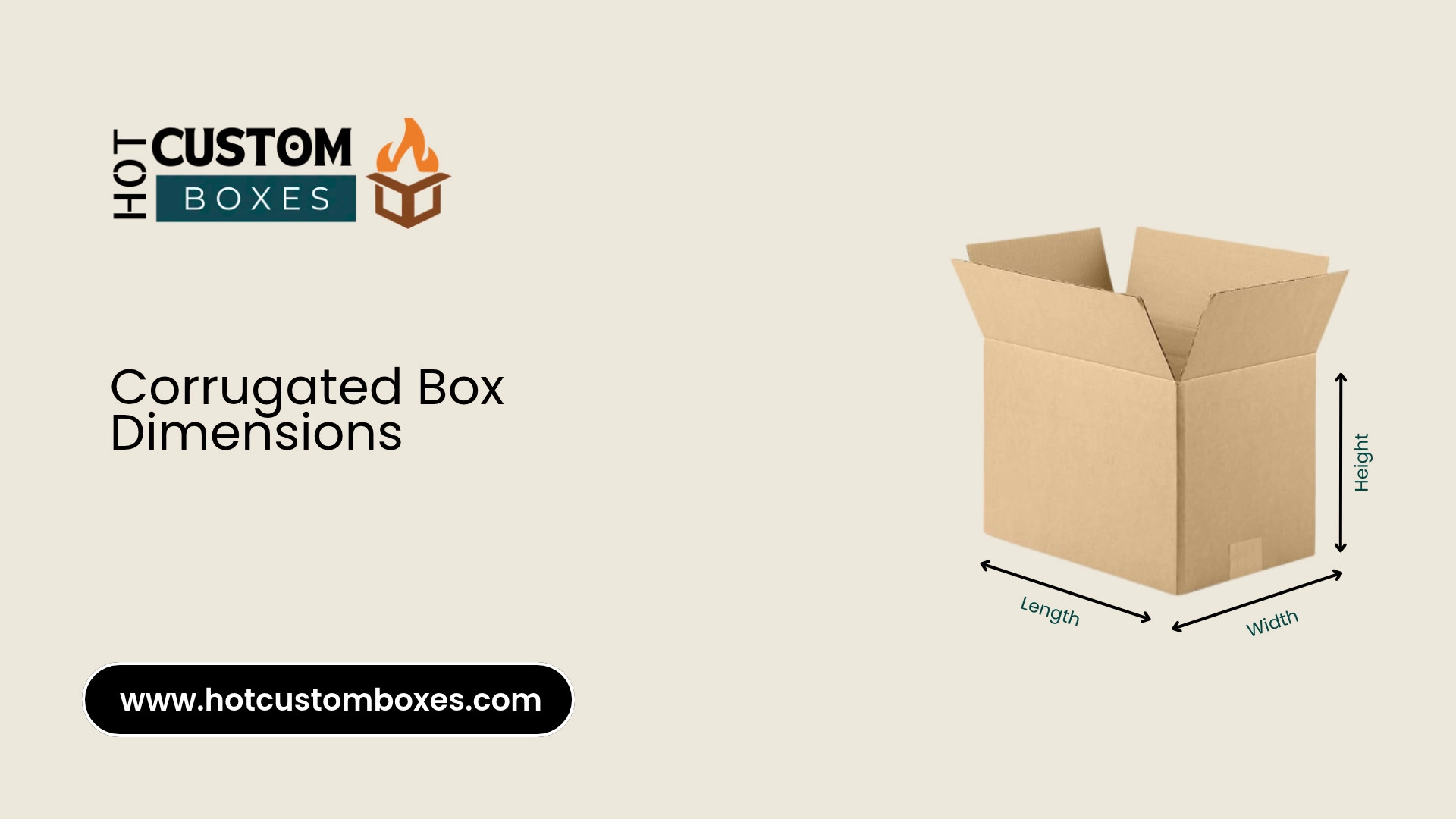
Table of Contents
Get A Free Quote
A corrugated box listed as 12 × 10 × 6 inches can measure close to 12.3 × 10.3 × 6.6 inches on the outside. Both sets of numbers are correct. Your product only cares about the first set. UPS, FedEx and USPS bill you on the second.
That gap comes from the board itself. Corrugated walls have real thickness. The thicker the board, the bigger the difference between the space inside and the size of the package outside.
This guide shows how to measure a corrugated box the right way, how much each wall type adds and which numbers to send a box manufacturer. It also covers how carriers round your measurements and why a fraction of an inch can add pounds to your shipping bill. If you only need the basics of length, width and height, start with our box dimensions guide.
What Is the Difference Between Inside and Outside Dimensions?
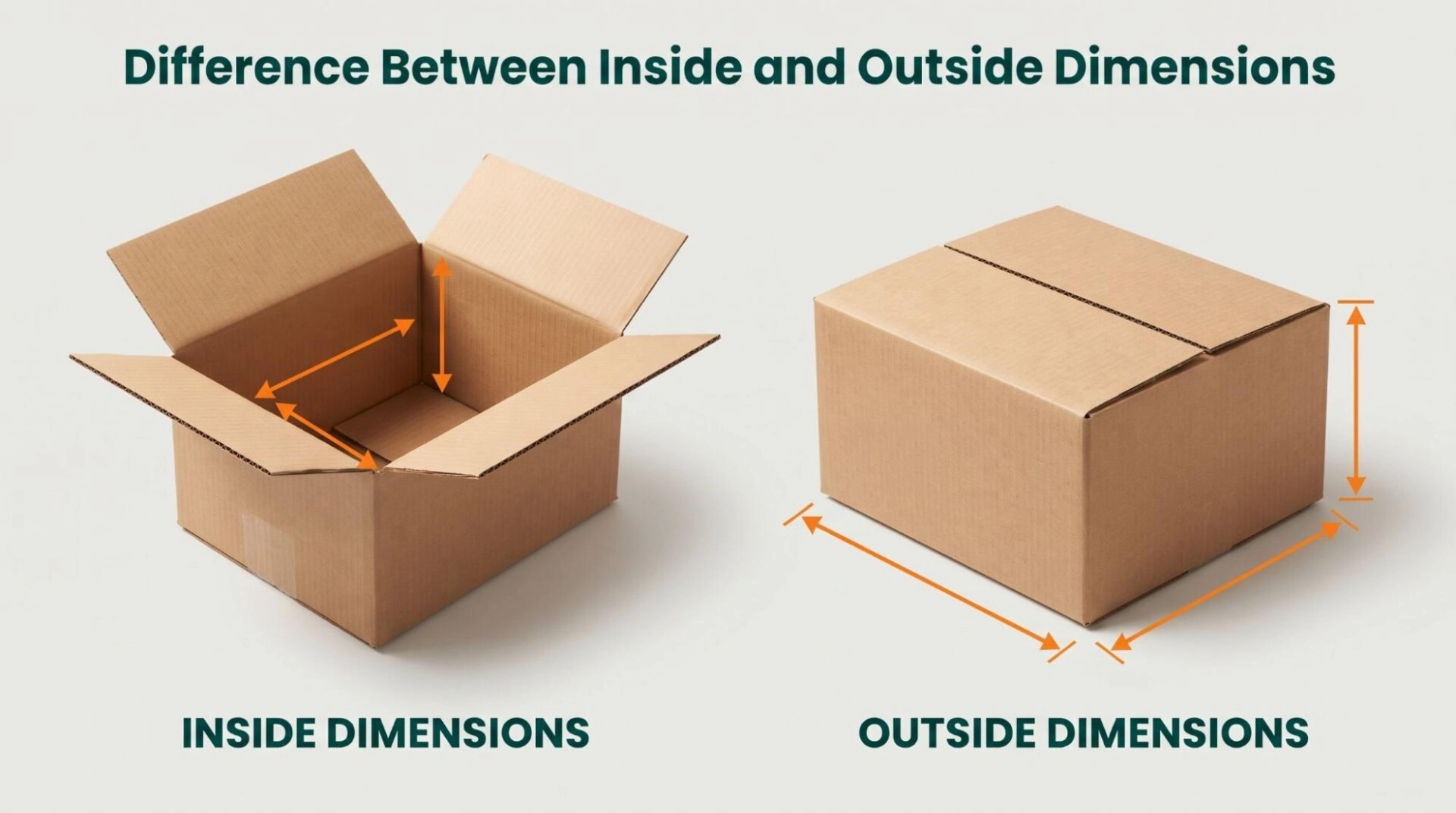
Inside dimensions measure the empty space your product sits in. Outside dimensions measure the box from its outer surfaces, including the board on every side. The Fibre Box Association puts it simply: inside dimensions are for fitting the product, while outside dimensions are used for carrier rules and pallet patterns (Fibre Box Handbook glossary).
Most box makers quote corrugated boxes by inside dimensions unless they say otherwise. Always check which set a supplier lists before you compare two quotes.
How much does the board add?
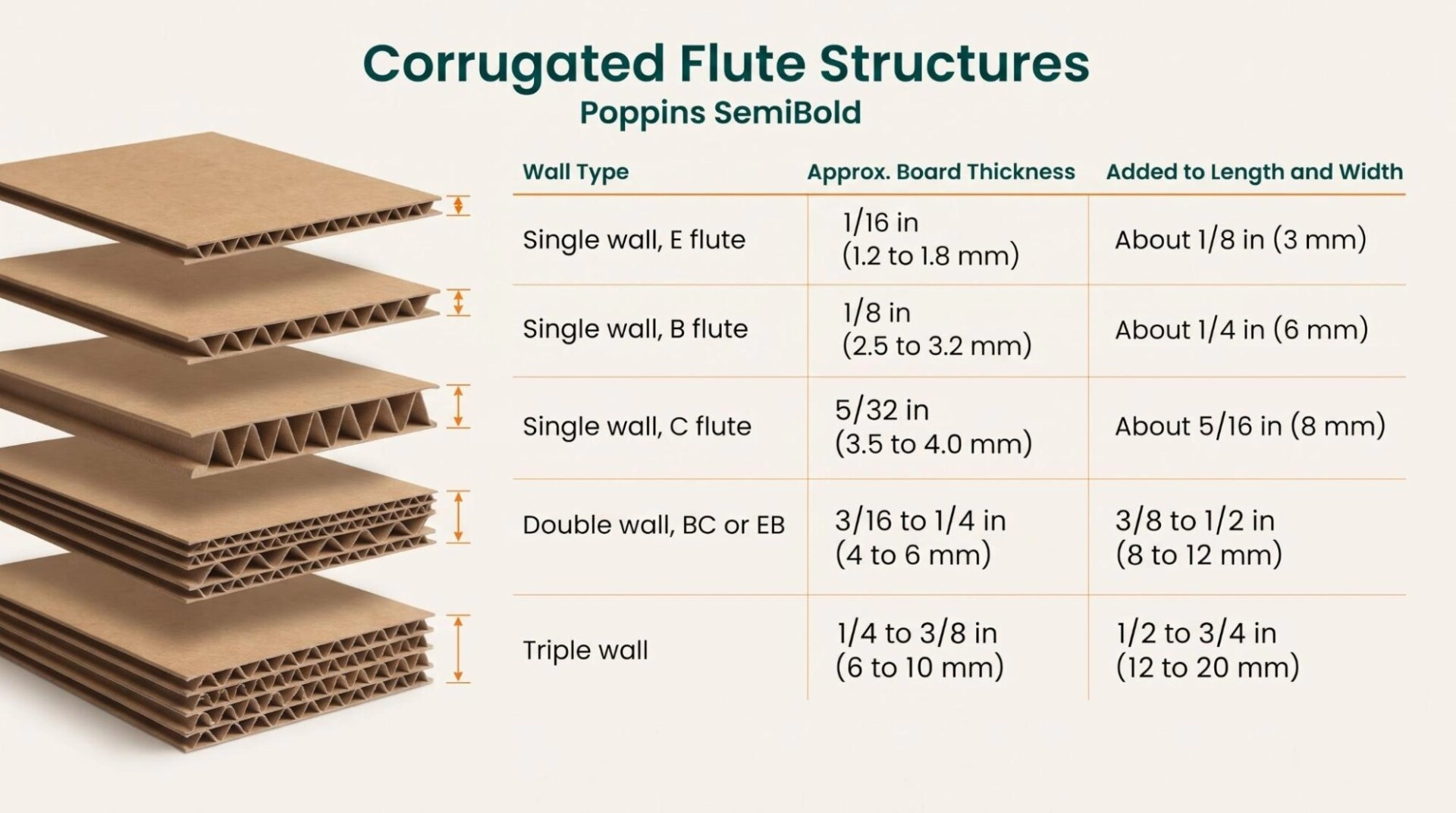
A quick rule of thumb works for a regular slotted container (RSC), the standard four-flap shipping box. Length and width grow by about two board thicknesses, one for each side. Height grows by about four, because the flaps stack two layers deep at both the top and the bottom.
| Wall type | Approx. board thickness | Added to length and width | Added to height (RSC) |
|---|---|---|---|
| Single wall, E flute | 1/16 in (1.2 to 1.8 mm) | about 1/8 in (3 mm) | about 1/4 in (6 mm) |
| Single wall, B flute | 1/8 in (2.5 to 3.2 mm) | about 1/4 in (6 mm) | about 1/2 in (12 mm) |
| Single wall, C flute | 5/32 in (3.5 to 4.0 mm) | about 5/16 in (8 mm) | about 5/8 in (15 mm) |
| Double wall, BC or EB | 3/16 to 1/4 in (4 to 6 mm) | 3/8 to 1/2 in (8 to 12 mm) | 5/8 to 1 in (16 to 24 mm) |
| Triple wall | 1/4 to 3/8 in (6 to 10 mm) | 1/2 to 3/4 in (12 to 20 mm) | 1 to 1 1/2 in (24 to 40 mm) |
Board thickness ranges are the approximate specs we use at Hot Custom Boxes. Other manufacturers run slightly different numbers. Mailer boxes and other die cut styles also grow differently from an RSC. Treat these as planning numbers, then confirm the final outside size with your manufacturer.
If you’re not sure which wall type you need, our guide to custom corrugated boxes compares single, double and triple wall. For flute thickness in more detail, see corrugated flute types.
How Do You Measure a Corrugated Box Correctly?
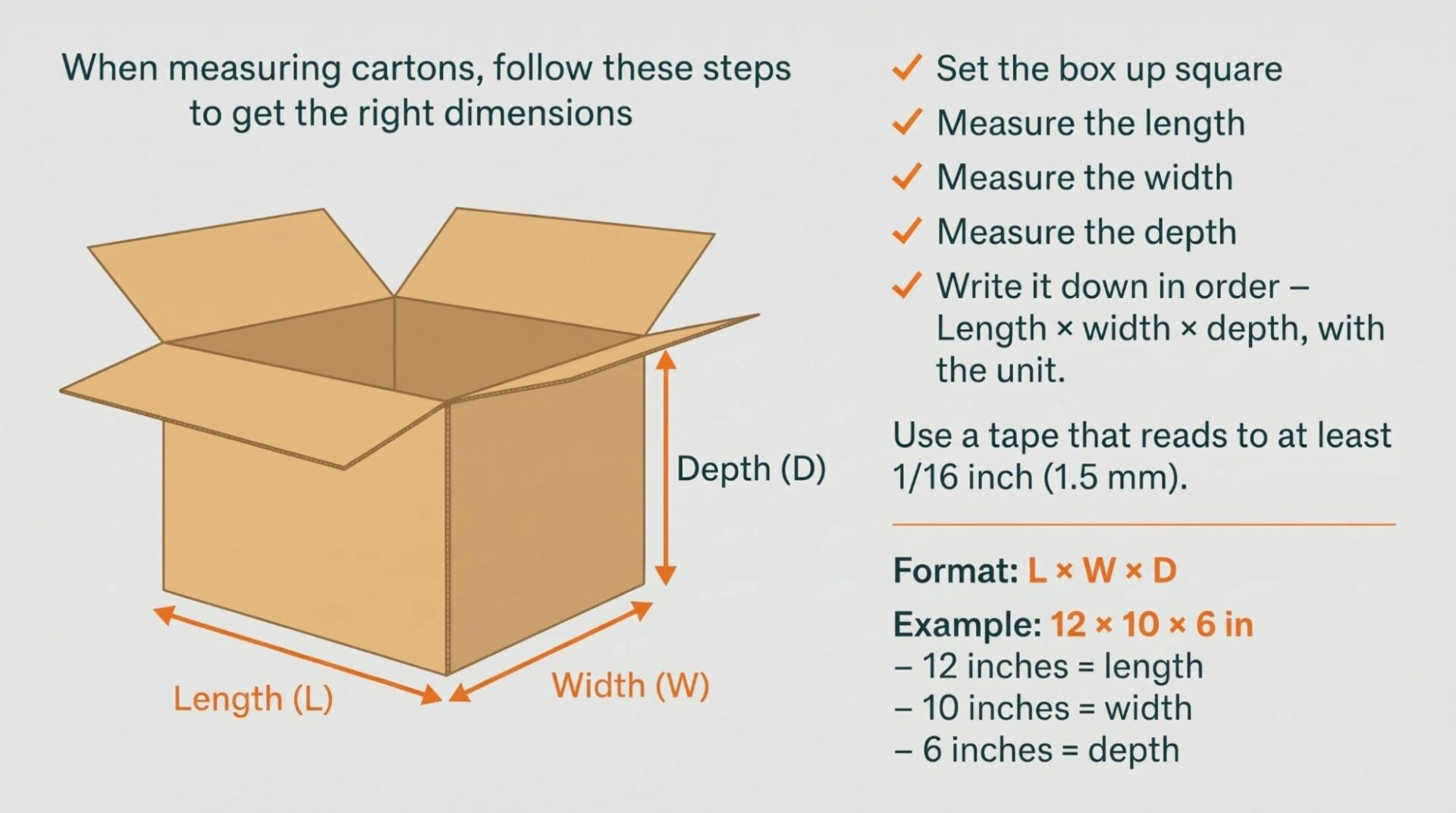
Measure an existing box from the inside, at the open top, in the order length, width and depth. Length is the longer side of the opening. Width is the shorter side. Depth (also called height) runs from the opening down to the floor of the box. That’s the order both the Fibre Box Association and the ASTM test method for box dimensions use.
Here’s how to do it step by step:
- Set the box up square. Fold the bottom flaps closed and stand the box on a flat table. A box that leans gives you a wrong reading.
- Measure the length. Run a rigid tape or ruler across the longer side of the opening, from inside wall to inside wall, just above the bottom.
- Measure the width. Do the same across the shorter side of the opening.
- Measure the depth. Go from the floor of the box straight up to the top score line, where the top flaps fold.
- Write it down in order. Length × width × depth, with the unit. For example, 12 × 10 × 6 in (305 × 254 × 152 mm).
- Measure the outside too if you ship it. Close and tape the box, then measure the longest point of each side, including any bulge.
Use a tape that reads to at least 1/16 inch (1.5 mm). That’s the precision ASTM D2658, the standard test method for fiberboard box dimensions, asks for (ASTM D2658). The same standard also says to check that a box is square before you measure it.
One detail trips people up. Length and width always describe the opening, even on a tall box. A box that opens at 6 × 6 inches and stands 14 inches tall is a 6 × 6 × 14, not a 14 × 6 × 6.
What Size Box Does Your Product Need?
Your box’s inside dimensions should equal your product’s size plus the space you need around it on every side. That space depends on how the box ships and what holds the product in place.
Start by measuring the product itself, not its current box. Measure at the widest points, including handles, caps or anything that sticks out. Then add clearance on both sides of each measurement:
| How the product is packed | Clearance to add per side | Example: product 10 × 8 × 4 in |
|---|---|---|
| Snug retail or display box, no cushioning | 1/16 to 1/8 in (1.5 to 3 mm) | about 10 1/4 × 8 1/4 × 4 1/4 in inside |
| Fitted corrugated insert | the insert’s thickness plus 1/8 in | depends on the insert design |
| Loose fill or crumpled paper | at least 2 in (5 cm) | 14 × 12 × 8 in inside |
| Box inside a box | outer box at least 6 in (15 cm) larger than the inner box | inner 11 × 9 × 5 in, outer 17 × 15 × 11 in |
The two inch and six inch figures come from UPS packing guidance. UPS recommends at least two inches of loose fill or crumpled paper between the contents and the box. For the box-in-box method, it says the outer box should be six inches larger than the inner box with about three inches of cushioning around it (UPS, January 2026).
Notice how fast loose fill grows the box. The 10 × 8 × 4 product needs a 14 × 12 × 8 box with loose fill, which is nearly four times the volume of a snug fit. A fitted insert often protects just as well in a much smaller box. Our guide to custom inserts and dividers shows the options.
What if you’re packing several items? Arrange them the way they’ll sit in the box, then measure the group as one block.
Which Dimensions Should You Send a Box Manufacturer?
Send inside dimensions in the order length × width × depth. Say clearly that they’re inside dimensions. Add the product size and weight as well, so the manufacturer can check the fit and suggest the right board.
A good size request includes:
- Inside dimensions (L × W × D) with the unit, marked “inside”
- The product’s own size and weight, measured at its widest points
- How it ships: single parcels, pallets or store shelves
- Box style, such as a regular slotted container or a mailer
- Any insert or cushioning you plan to use, with its thickness
- An outside size limit, if you have one. Maybe the box must fit a shelf, a retail display or a carrier size tier.
That last point matters more than most buyers think. If the outside size has to stay under a limit, tell the manufacturer up front. They can then work backward from the outside and set the inside to match the board you choose.
The best way to check all of this is a flat dieline or a physical sample before production. Our post on box templates explains how to read the flat layout.
How Do Box Dimensions Change Shipping Costs?
Parcel carriers charge for the space a box takes up, not only its weight. They multiply the outside length, width and height in inches, divide by a number called the DIM divisor and bill whichever is higher: that dimensional weight or the actual weight. UPS Daily Rates, FedEx and USPS now all use a divisor of 139. All three also round each side up to the next whole inch first.
| Carrier | Divisor | When it applies | Rounding |
|---|---|---|---|
| UPS | 139 for Daily Rates, 166 for Retail Rates | All packages | Each side rounded up to the next whole inch |
| FedEx | 139 | All packages in customer packaging | Each side rounded up since August 18, 2025 |
| USPS | 139 since July 12, 2026 (was 166) | Parcels over 1,728 cubic inches (1 cubic foot) | Each side rounded up to the next whole inch |
| Canada Post | 139 (or 5,000 in cm) for Priority, Xpresspost, Expedited and U.S. or international parcels. 166 (or 6,000 in cm) for Regular Parcel. | Rated on the greater of actual or volumetric weight | Check the current customer guide |
Sources: UPS, FedEx, Parcel Industry, April 2026, USPS rule in the Federal Register, May 2026, Canada Post. Negotiated contracts can use a different divisor, so check your own rate agreement.
Why a fraction of an inch matters
The round-up rule is where board thickness starts costing money. Take two boxes made from C flute board for a light product:
| Specifications | Box A | Box B |
|---|---|---|
| Inside dimensions | 12 × 10 × 6 in | 11.6 × 9.6 × 5.3 in |
| Approx. outside dimensions | 12.3 × 10.3 × 6.6 in | 11.9 × 9.9 × 5.9 in |
| Billed as | 13 × 11 × 7 in = 1,001 cu in | 12 × 10 × 6 in = 720 cu in |
| Dimensional weight at 139 | 7.2, billed as 8 lb | 5.2, billed as 6 lb |
Box B is only slightly smaller inside, yet it bills 2 pounds lighter on every UPS or FedEx parcel. Over thousands of orders, that adds up fast. Neither box crosses 1,728 cubic inches, so USPS would bill both on actual weight.
The lesson is simple. If your product allows it, size the inside so the outside lands just under a whole inch. Ask your manufacturer to confirm the real outside size before you approve the order. For more ways to cut freight costs, read our guide on reducing shipping costs with smart packaging.
How Many Box Sizes Do You Need?
Most small and mid-size brands do well with a short range of box sizes, each one covering a group of similar products. Too few sizes and you ship air. Too many and you tie up cash and shelf space in boxes.
A simple way to plan the range:
- List every product or common order bundle with its packed size and weight.
- Sort the list by volume, smallest to largest.
- Group items whose sizes sit within about an inch of each other.
- Size one box to the largest item in each group, plus the clearance it needs.
- Use a corrugated insert or divider to hold smaller items in that group steady.
- Check each box against the dimensional weight table above, especially sizes that land just over a whole inch outside.
Pallets and store shelves follow the outside size, not the inside. The Fibre Box Association notes that outside dimensions drive pallet patterns (Fibre Box Handbook glossary). If your boxes ship to retailers on pallets, give your manufacturer the pallet size and any height limit so the boxes stack without overhang.
Which Measuring Mistakes Cost the Most?
The costliest mistakes are mixing up inside and outside sizes and forgetting how carriers round. Here are the ones to watch for:
- Comparing an inside quote with an outside quote. Two suppliers can list the same box with numbers that differ by half an inch or more. Ask every supplier which set they mean.
- Ordering by outside size when the product needs a set inside space. On double or triple wall, the box can arrive close to an inch too small inside.
- Measuring a used box that has bowed. A box that’s been packed and taped once rarely stays square. Measure a fresh, flat-packed sample instead.
- Leaving out what sticks out. Pumps, caps, handles and hang tags all count. Measure at the widest point.
- Ignoring the round-up rule. An outside size of 12.1 inches is measured as 13 by UPS, FedEx and USPS.
- Using an old USPS divisor. Shipping calculators and old blog posts may still use 166. Since July 12, 2026, USPS uses 139 for parcels over one cubic foot.
- Writing dimensions in the wrong order. A 6 × 6 × 14 tall box and a 14 × 6 × 6 long box are not the same box. Length and width always describe the opening.
How Do You Order a Custom Size Corrugated Box?
Send your product size, the inside dimensions you want and how the box will ship. A custom size box is built to those numbers, so you don’t have to fit your product into the nearest stock size.
At Hot Custom Boxes, every corrugated box can be made to any size you need. Orders start at 50 boxes, so you can test a size before a large run. Our design team helps at no charge. The die and printing plates are free too. Before production you’ll see a flat view and a 3D mockup with your exact dimensions. If you want to check the fit by hand, ask for a physical sample. Shipping is free.
Choose the wall type to match the product. Light items usually fit well in single wall boxes, while heavier or fragile goods may need double wall or triple wall boxes. Remember that thicker board adds more to the outside size. Browse the full corrugated boxes range for styles and colors.
Get the Right Box Size the First Time
Good box sizing comes down to three numbers working together: the product, the inside of the box and the outside the carrier measures. Size the inside for the product, check the outside against the round-up rule and you’ll stop paying to ship empty space.
Have your measurements ready? Ask for a quote with your product size and the inside dimensions you want. We’ll confirm the outside size and send a 3D mockup at no cost. Not sure how much room your product needs? Talk to our packaging team and we’ll work it out with you.
Frequently Asked Questions
Most manufacturers list corrugated boxes by inside dimensions, in the order length × width × depth. Carriers, pallets and shelves work from the outside size. If a listing doesn’t say which, ask before you order.
On a standard single wall C flute shipping box, the outside is roughly 5/16 inch (8 mm) longer and wider and about 5/8 inch (15 mm) taller than the inside. Double and triple wall boxes add more, up to about 1 1/2 inches in height on triple wall.
Length, then width, then depth. Length and width are the long and short sides of the opening. Depth runs from the opening to the floor, even when it’s the biggest number.
UPS Daily Rates, FedEx and USPS use 139 for parcels in the U.S. USPS switched from 166 to 139 on July 12, 2026. It applies dimensional weight only to parcels over 1,728 cubic inches. UPS Retail Rates still use 166.
For a snug retail box, about 1/16 to 1/8 inch per side. For loose fill or crumpled paper, UPS recommends at least two inches between the product and the box walls. A fitted insert usually lets you use a much smaller box.
Related Products
$10.00 Original price was: $10.00.$5.00Current price is: $5.00.
In Stock
$0.50 Original price was: $0.50.$0.10Current price is: $0.10.
In Stock
$0.50 Original price was: $0.50.$0.10Current price is: $0.10.
In Stock
$10.00 Original price was: $10.00.$5.00Current price is: $5.00.
In Stock